VI
VI EN
EN
The Hidden Costs of Cardboard in Industrial Settings
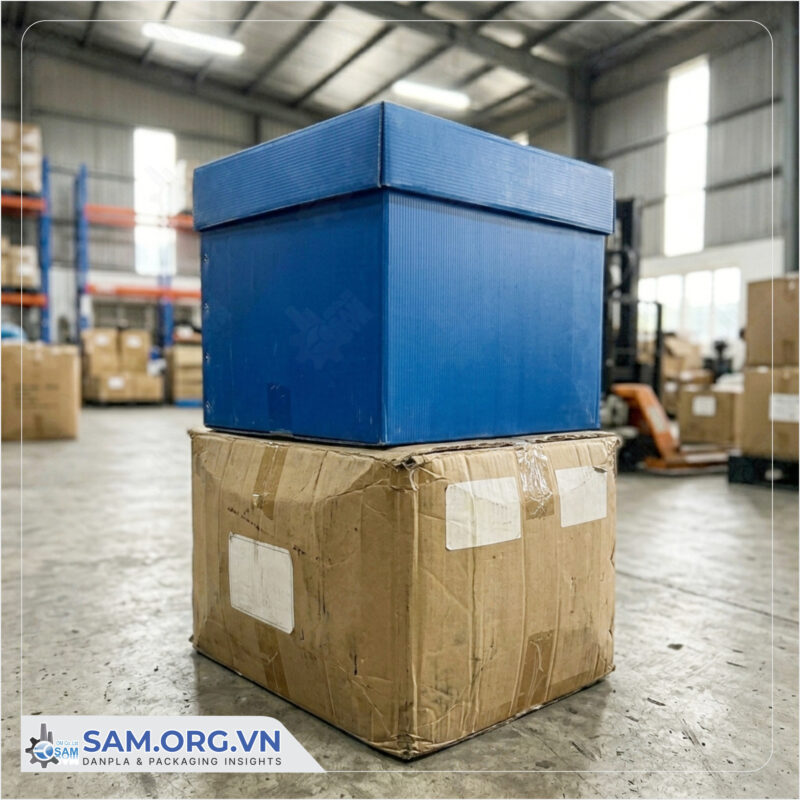
Cardboard has been the default packaging material in industrial production for decades. It is cheap, widely available, and easy to label. However, as production lines accelerate and international shipping standards rise, the real cost of cardboard becomes visible. That cost does not appear on the purchase invoice. Instead, it shows up in damaged goods, collapsed boxes after a single transit, and the ongoing cost of replacing packaging. For this reason, more manufacturers in Vietnam are replacing cardboard with Danpla PP corrugated plastic.
This shift is not a trend driven by materials preference. It is a financial decision grounded in lifecycle cost analysis. When businesses compare the total cost of cardboard over 12 months against the total cost of Danpla over the same period, the calculation consistently favors Danpla for operations with frequent shipping cycles.
Short Lifespan and Recurring Replacement Costs
A standard cardboard box withstands 3 to 5 uses before it needs replacing. For a factory running hundreds of shipments per month, this volume adds up quickly. The unit cost of each new box appears small. However, when you add labor for sorting and disposing of old boxes, plus storage space for excess packaging materials, the actual total is considerably higher than initial procurement estimates suggest.
Many procurement teams do not track these costs in sufficient detail. Replacement expenses are often distributed across multiple budget lines, making the true annual packaging cost difficult to see in a single report. Additionally, used cardboard accumulates dust and provides a favorable environment for microbial growth, particularly in temperature-controlled warehouses. For pharmaceutical and food manufacturers, this represents a compliance risk. In many facilities, entire batches of cardboard boxes must be discarded after each warehouse hygiene inspection, adding unpredictable costs to the packaging budget.
Moisture Damage and Load-Bearing Failure
Cardboard loses 30 to 50% of its structural strength when ambient humidity exceeds 70%. In Vietnamese warehouses, particularly between April and September, humidity regularly reaches 80 to 90%. Boxes at the bottom of a stack bear the full weight of the layers above. As a result, they collapse under normal humidity conditions. Electronics and sensitive components fail not because of rough handling but because the box loses its shape.
In ocean freight, cargo endures temperature fluctuations and salt moisture over 15 to 45 days at sea. Cardboard was not designed to withstand this environment repeatedly. Consequently, claims for damaged goods attributable to weak packaging represent a significant portion of international cargo insurance disputes.
How Corrugated Plastic Solves the Packaging Cost Problem
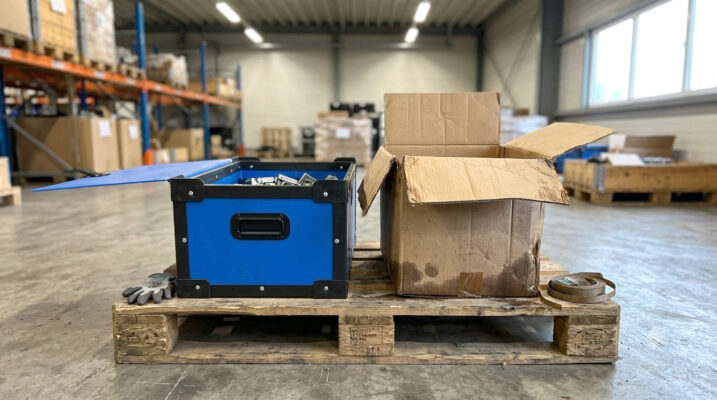
Danpla is a PP corrugated plastic sheet made from 100% virgin polypropylene. Its twin-wall flute structure delivers high rigidity at low weight. Thickness options range from 2mm to 10mm, with maximum sheet dimensions of 2,100mm. Danpla does not absorb moisture, does not crack under correct load conditions, and can be reused many times in real production environments.
Long Service Life and Real ROI
A set of reusable corrugated plastic boxes manufactured to the correct load-bearing thickness can withstand 200 to 500 uses, depending on operating conditions. In comparison, cardboard manages 3 to 5 uses. If a Danpla box costs 5 to 7 times more than a cardboard box of the same size, but lasts 60 to 100 times longer, the lifecycle cost is significantly lower. For companies shipping weekly, the investment typically pays back within 12 months.
For exporters running 300 to 500 shipments per month, reducing new box purchases and disposal costs creates measurable savings in the annual operating budget. Moreover, the savings distribute across multiple cost lines: reduced repacking labor, lower waste disposal fees, and fewer losses from goods damaged by packaging failure.
Need technical advice tailored to your production line? Contact SAM’s engineering team — free, no obligation: +84 363 939 228 (Mr. Đạt)
Dimensional Consistency for Warehouse Automation
Cardboard purchased from multiple batches varies in thickness and strength. This inconsistency creates problems when stacking automatically or calculating rack load limits. In contrast, Danpla is manufactured through a controlled extrusion process with thickness tolerance of ±0.1mm and fixed dimensions per drawing. Corrugated plastic boxes from SAM carry ISO 9001:2015 certification, with quality checks on every outgoing batch.
Dimensional consistency is critical for automated warehouse systems. Robots and conveyors cannot process boxes that fall outside dimensional tolerances. For this reason, many Japanese and Korean electronics assembly plants in Vietnam specify Danpla packaging at the line-design stage, rather than retrofitting after cardboard operations have already started and problems have emerged.
Corrugated Plastic Versus Cardboard: Performance Metrics
When the two materials are tested under identical warehouse conditions, the performance difference compounds over time in favor of Danpla.
Load Capacity, Impact Resistance, and Moisture
Standard BC triple-wall cardboard handles stacking loads of 8 to 12 kg/m² in dry conditions. At 75% humidity, this drops to 4 to 6 kg/m². By contrast, 4mm Danpla sustains 25 to 35 kg/m² in humid conditions with negligible reduction. Furthermore, the twin-wall PP flute structure disperses impact force more effectively than cardboard of equivalent weight, making it better suited for multi-handling logistics chains.
On weight, 4mm Danpla weighs approximately 800g/m², similar to BC triple-wall cardboard of the same area. Therefore, switching to Danpla does not increase freight costs for weight-based shipping. A detailed comparison of technical specifications is available in the published article on 6 advantages of corrugated plastic over carton.
Additionally, Danpla is recyclable at end of life. The PP material can be ground and reprocessed into new sheets. As a result, the total packaging waste generated by companies using reusable Danpla is typically lower than the cardboard waste from single-use packaging operations, calculated over the same annual shipment volume.
Which Industries Benefit Most from Switching
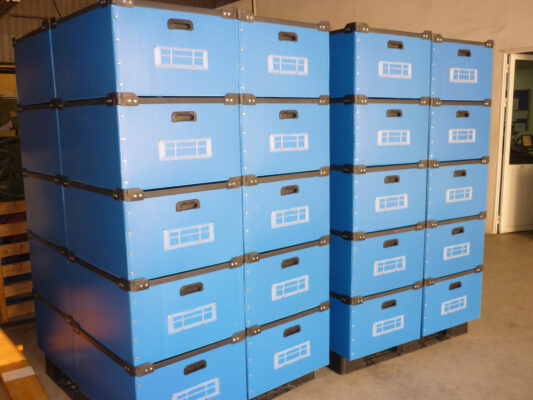
Not every business gains equally from replacing cardboard with Danpla. The clearest benefits appear in industries with high shipping frequency, moisture-sensitive products, or specific warehouse requirements.
Electronics and Precision Components
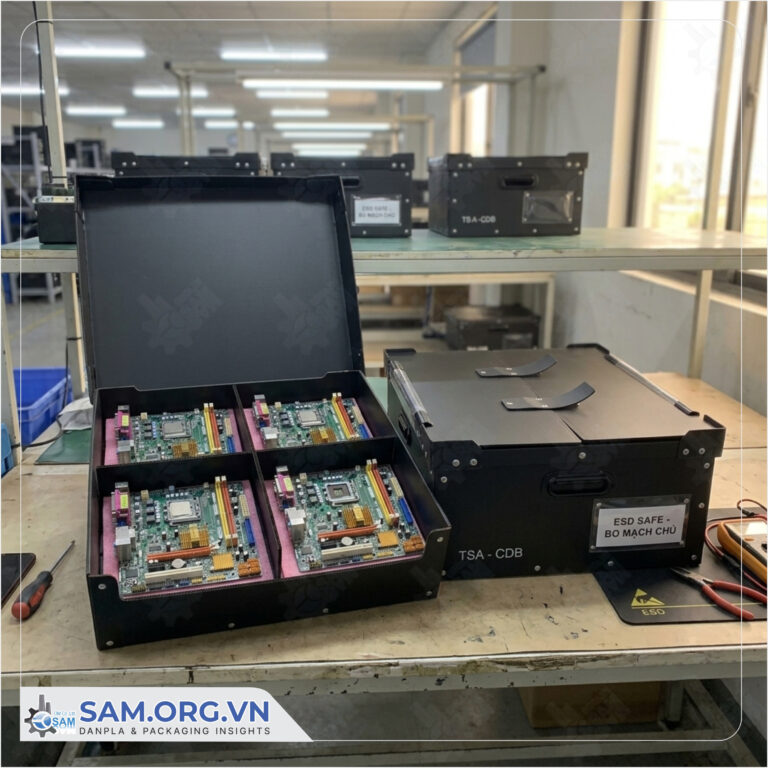
Electronics components require packaging that maintains dimensional stability, generates no paper dust, and can incorporate ESD-protective dividers. Cardboard does not meet all these requirements consistently across production batches. In contrast, Danpla with integrated dividers provides precise compartment separation, produces no dust, and can be coated with a conductive ESD layer when needed. This makes Danpla the standard packaging choice in SMT and PCB assembly facilities.
SAM supplies Corrugated plastic sheets and partitions to electronics manufacturers across Vietnam. Products are exported to Japan, South Korea, and the United States, manufactured to ISO 9001:2015 and ISO 14001:2015, and verified by SGS.
Export Logistics and International Shipping
For ocean freight, packaging must withstand multiple loading and unloading cycles, temperature swings, and salt moisture inside containers over long voyages. Danpla at 5mm to 8mm thickness works well as outer packaging for container cargo, reducing the damage rate on long routes. Several exporters in Hai Phong and Binh Duong have adopted Danpla for shipments to Australia and the United Kingdom, where transit times reach 20 to 40 days.
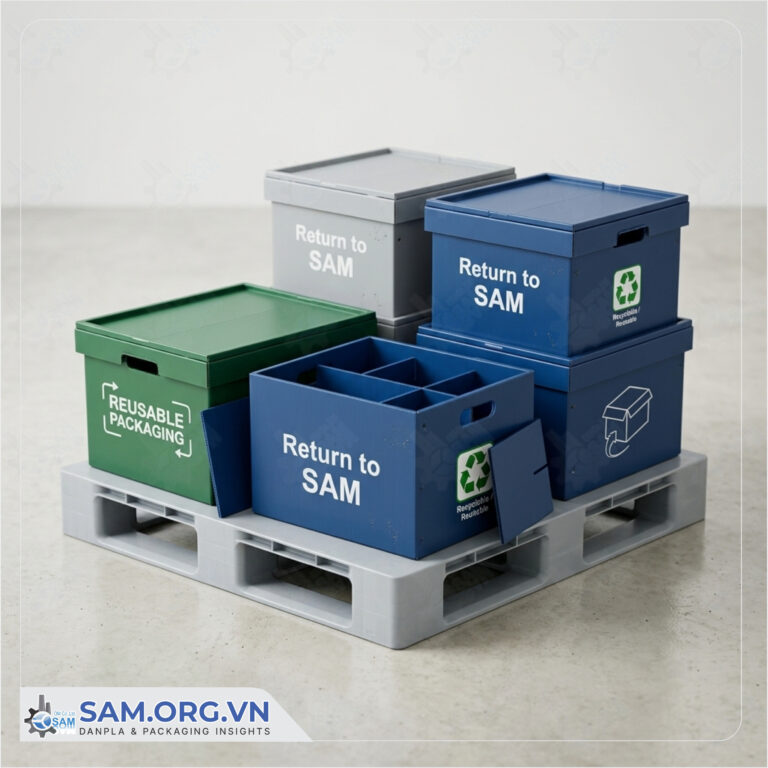
From an environmental standpoint, reusable Danpla packaging aligns with ESG requirements that large import partners are increasingly imposing on their supply chains. For more on supply chain benefits and cost recovery models, see the published article on returnable packaging.
Frequently Asked Questions
Can corrugated plastic completely replace cardboard in all applications?
Not in every case. Danpla is most suitable for reusable packaging within a closed supply chain loop: factory to warehouse to assembly point and back. For retail packaging requiring complex full-color printing, or for single-use applications, cardboard remains the more economical choice. The right approach is to analyze shipment frequency and storage conditions before committing to a full switch.
How long does it take to recover the investment when switching from cardboard to corrugated plastic?
It depends on usage frequency. For companies shipping weekly, a set of Danpla boxes typically pays back within 6 to 12 months. At lower frequencies, the payback period extends to 18 to 24 months. However, the calculation should include the full cost of cardboard: labor for replacement, losses from damaged goods, and waste disposal fees. When these hidden costs are counted, the ROI for Danpla is usually shorter than initial estimates suggest.
Does SAM produce custom-sized corrugated plastic boxes to specification?
Yes. SAM manufactures Danpla boxes and dividers to customer technical drawings. Thickness options run from 2mm to 10mm, with 20 standard colors available plus custom color matching on request. Maximum dimension is 2,100mm. Sample production lead time is typically 5 to 7 business days. SAM’s engineering team supports load calculations and recommends the correct thickness for each customer’s specific operating conditions.