VI
VI EN
EN
What Is Returnable Packaging in the B2B Supply Chain?
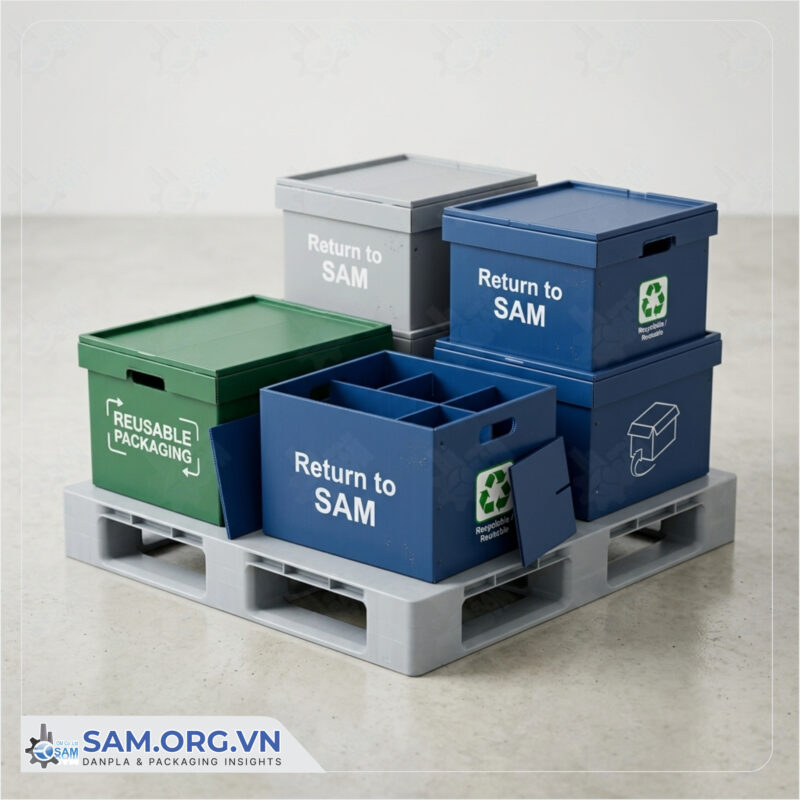
Returnable packaging — also called reusable industrial packaging — is purpose-built packaging designed to complete multiple trips between manufacturer, supplier, and distribution point. Instead of being discarded after each shipment, returnable packaging is collected, cleaned, and re-entered into the supply chain until it reaches end of mechanical service life.
This model is the direct opposite of single-use packaging such as corrugated cardboard boxes, plastic bags, or EPS trays. In high-volume B2B manufacturing, single-use packaging costs compound fast. A mid-size electronics factory consuming 50,000 cardboard boxes per month can cut packaging costs by over 90% within 8–10 months. The switch: reusable Danpla PP boxes rated for 80 trips per unit.
ISO 14021 defines reusable packaging as packaging that can perform its function multiple times within its designed service life — without recycling or reprocessing between uses. Major multinationals increasingly list a minimum returnable packaging ratio as a binding procurement requirement for Tier 1 and Tier 2 suppliers.
In Vietnam, FDI factories in electronics (Samsung, LG, Foxconn) and automotive (Toyota, Honda, Thaco) have operated returnable packaging systems for years. The practice is spreading to domestic manufacturers as downstream pressure from international customers intensifies.
Common Types of Returnable Packaging in Industry
PP Corrugated Plastic Boxes — the Most Versatile Option
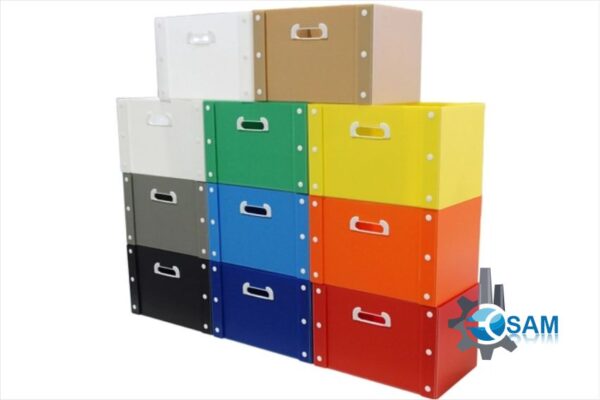
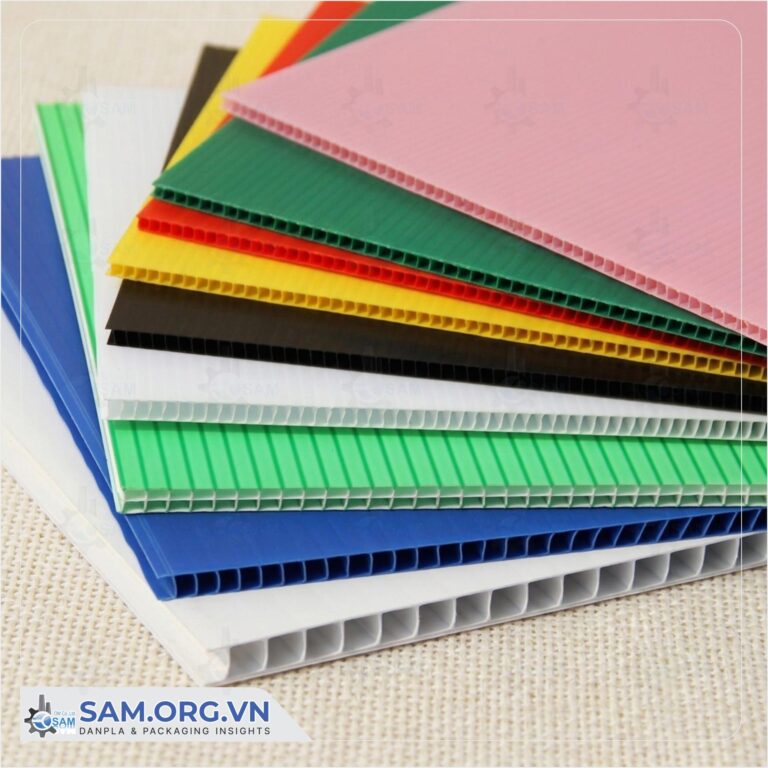
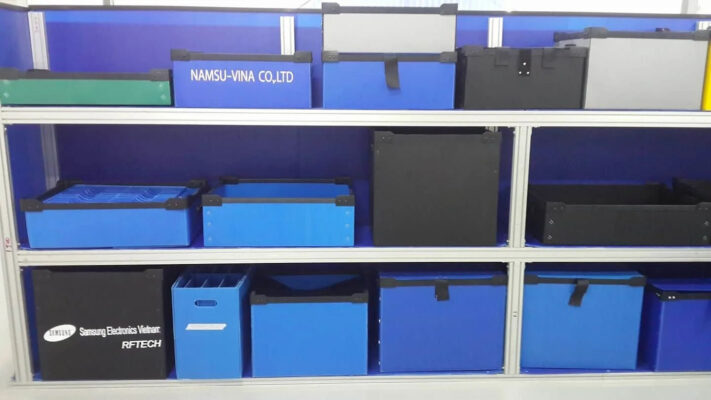
Boxes made from Danpla corrugated polypropylene sheet are the most widely used returnable packaging format in manufacturing. The hollow-channel structure makes Danpla 60% lighter than solid plastic of equivalent rigidity. Boxes handle stacking loads of 15–20 kg, are fully waterproof, and wipe clean between trips.
Thickness ranges from 2 to 10 mm. Dimensions are custom-made to match each customer’s production line. Service life averages 3–5 years (60–100 trips). SAM manufactures Corrugated plastic boxes and partitions to customer engineering drawings, with lead times of 7–14 working days depending on order volume.
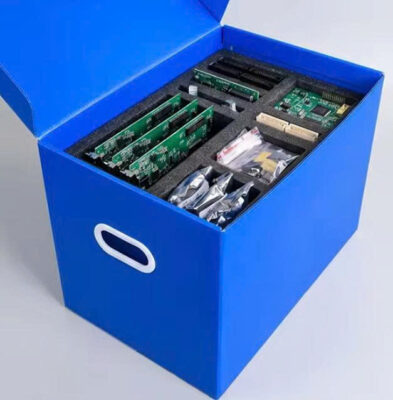
Internal dividers — also cut from Corrugated plastic sheets — prevent components from contacting each other during transit. This is a mandatory requirement in electronics and precision component handling.
Plastic Pallets, Formed Trays, and IBCs
Returnable packaging ecosystems include several other formats depending on cargo type and line requirements:
- HDPE/PP plastic pallets: rated at 1,000–1,500 kg, forklift-compatible, service life 10+ years, hundreds of trips.
- EPS or PE foam formed trays: hold small components in fixed positions, with ESD variants for static-sensitive parts.
- IBCs (Intermediate Bulk Containers): steel-framed plastic tanks for industrial liquids and chemicals, reused 10–15 times.
Choosing the right format depends on cargo weight, trip frequency, hygiene requirements, and storage conditions (temperature, humidity, electrostatic sensitivity). Technical consultation from the manufacturer helps optimize buffer stock levels and collection intervals from the design stage.
Financial Benefits of Switching to Returnable Packaging
Long-Term Cost Reduction
A straightforward ROI calculation based on real trip frequency:
- 5-ply corrugated cardboard box: VND 35,000/unit, single use → cost per trip: VND 35,000.
- Equivalent Danpla box: VND 180,000/unit, 80 trips → cost per trip: VND 2,250.
- Net saving (after 20–30% recovery logistics cost): approximately 88–90% per trip.
A factory using 10,000 boxes per month typically reaches payback in under 8 months. Ongoing packaging cost then drops to near the cost of recovery logistics — 70–80% lower than disposable packaging.
Beyond direct material savings, returnable packaging reduces packing labor time (no tape sealing, no box assembly), decreases empty-packaging storage area, and eliminates cardboard disposal at line end. These hidden costs are often omitted from initial assessments.
A detailed cost comparison is available in the Corrugated plastic vs. traditional carton advantages analysis.
Waste Reduction and ESG Compliance
ESG (Environmental, Social, Governance) requirements from multinationals are increasingly flowing down to Tier 1 and Tier 2 supply chains. Factories supplying Samsung, Panasonic, or Bosch must demonstrate measurable packaging waste reduction in annual sustainability reports.
Converting 50% of packaging to returnable can cut 30–50 tonnes of cardboard waste per year for a medium-size factory. This becomes a reportable, auditable ESG data point. Several Japanese and Korean multinationals already mandate a minimum 30% returnable packaging ratio in their supplier evaluation criteria.
Need technical advice on box specifications and minimum buffer stock to launch a returnable packaging system? Contact SAM’s engineering team — free
Returnable Packaging Applications in Vietnamese Factories
Electronics and Precision Components
Electronics manufacturing demands packaging that is reusable and controls electrostatic discharge and particulate contamination. Danpla boxes with ESD dividers (antistatic black Danpla, surface resistivity 10⁶–10⁹ Ω) are standard at plants assembling PCBs, semiconductor components, and wire harnesses.
A typical returnable packaging system in electronics:
- 2–4 mm Danpla boxes with ESD dividers, sized to KLT standard or custom specification.
- UV-resistant barcode/QR labels printed directly on box surface — tracking trip count and location in the WMS.
- Dedicated racks and trolleys for in-plant box movement without forklifts.
SAM supplies reusable corrugated plastic boxes to electronics customers at Dinh Vu Industrial Zone (Hai Phong), Thang Long Industrial Zone (Hanoi), and industrial parks in Binh Duong province.
Automotive, Heavy Engineering, and Metalworking
Automotive is the industry that most systematically applies returnable packaging. The Toyota Production System (TPS) Kanban model requires components from Tier 1 suppliers to arrive at the assembly plant in standardized boxes or pallets. These are collected and returned on the same truck — a closed loop with zero packaging waste per cycle.
Heavy metal parts such as brackets, shafts, and engine housings use steel bins lined with PE foam padding, or thick PP trays (5–10 mm). Requirements differ from electronics: load rating 20–80 kg per box, resistance to cutting oils and industrial grease, and structural integrity when stacked 4–6 high on flatbed trucks.
Mid-size metalworking SMEs can implement a simpler internal system: 3–4 standardized PP box sizes for all WIP movement between production stations, eliminating ad-hoc cardboard use on the shop floor entirely.
Frequently Asked Questions About Returnable Packaging
How is returnable packaging different from recyclable packaging?
Returnable packaging (reuse) and recyclable packaging are two distinct concepts. Reusable packaging is used again intact — no reprocessing, no melting. Recyclable packaging is collected, shredded, and manufactured into new raw material. Returnable packaging is more energy-efficient per unit of function. Each reuse cycle consumes no recycling energy.
Can small manufacturers implement returnable packaging?
Yes. The minimum condition is a fixed transport route to recover packaging efficiently after each delivery. At 500–1,000 boxes per month, the payback period for Danpla boxes is typically under 12 months. SAM provides consultation on box sizing, minimum buffer stock, and collection workflows so the returnable system runs smoothly from day one.
How long does a corrugated plastic box last in a returnable system?
Danpla boxes made from 100% virgin PP achieve a service life of 3–5 years under standard warehouse conditions (10–40°C, no continuous direct UV exposure). Average trip count: 60–100 for internal warehouse use, 40–60 for long-distance transport. Minor surface scratches do not affect function. Replace only when deformation or cracking affects stackability.
Can logos and barcodes be printed on corrugated plastic boxes?
Yes. SAM prints directly onto Danpla surfaces using UV-resistant ink, or applies heat- and moisture-resistant barcode/QR labels. Printable information includes company logo, product code, handling warnings, and QR codes linked to ERP/WMS systems. Labels adhere reliably on PP surfaces and withstand cold-store temperatures down to −20°C.