VI
VI EN
EN
The Packaging Challenge in Electronics Manufacturing
Electronics factories face packaging demands that differ from most industries. Components are small, varied, and sensitive to static and moisture. A single packaging error in the internal supply chain can trigger mass defects on an SMT line or in the semi-finished goods store.
Vietnam has become a key destination for major electronics groups from Japan, South Korea, and Taiwan. These factories bring internal packaging standards from their parent plants. As a result, local suppliers must meet both material quality requirements and the ability to customize to each production line.
Cardboard is a common initial choice because it is inexpensive. However, after a few cycles, cardboard absorbs moisture, sheds dust particles, and loses rigidity. Paper dust from cardboard boxes is a documented source of contamination on SMT lines, leading to pad defects and increased rejection rates.
Solid plastic boxes are more durable, but they are heavy and space-consuming when empty. Sizes depend on available molds. Changing dimensions requires new mold investment — a slow and costly process when a production line evolves.
Danpla PP corrugated boxes solve all three problems. They are lighter than solid plastic, fold flat when empty, and can be cut and folded to exact dimensions without any mold. This is why Danpla boxes for the electronics industry are widely used at FDI factories across Vietnam.
Technical Specifications of Corrugated Plastic Boxes
PP Corrugated Sheet: the Foundation
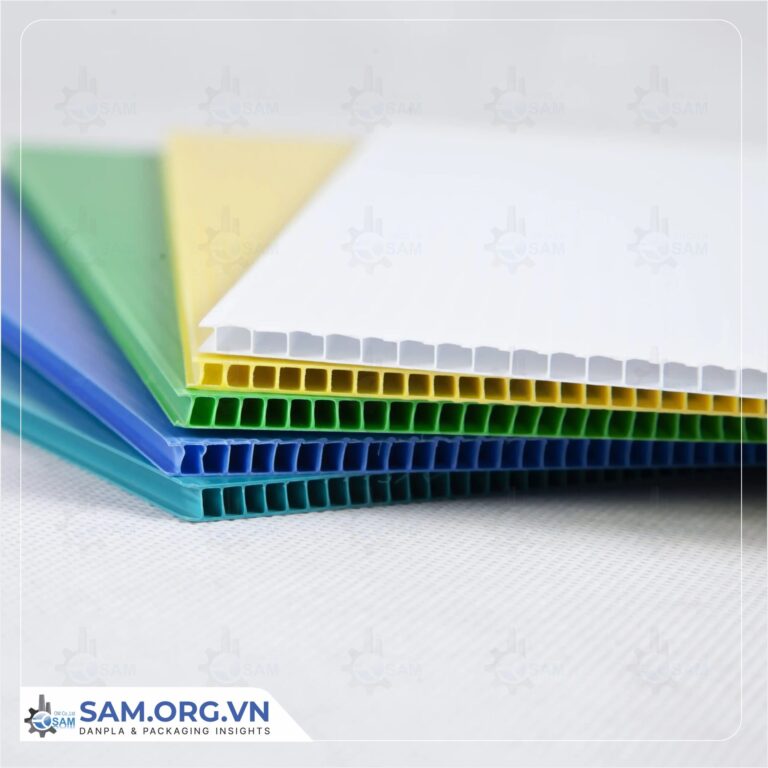
Danpla boxes are folded and joined from PP corrugated plastic sheet. The sheet has a three-layer structure: two flat facings sandwiching a rectangular fluted core. The fluted core provides rigidity and impact absorption without increasing the overall sheet thickness.
SAM produces boxes from sheets 2 to 10mm thick, with a maximum width of 2100mm. For electronics component circulation, 4mm and 5mm thicknesses are most common. This range is stiff enough to stack several layers on a rack yet light enough for manual handling on the production line.
The material is 100% virgin PP, free of chemical migration and dust particles. This is a fundamental requirement for SMT production environments and component warehouses with cleanliness standards.
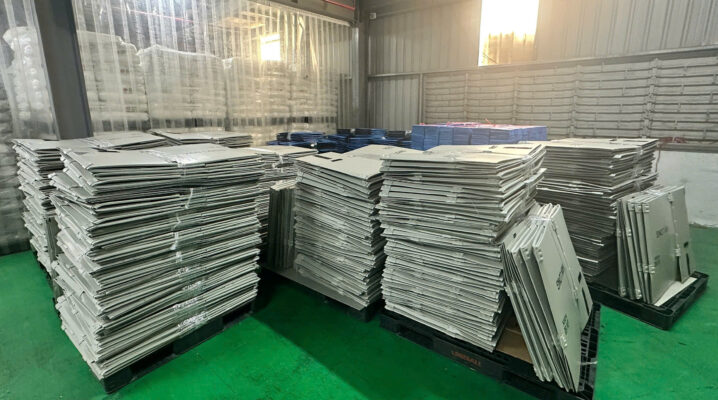
When empty, boxes fold completely flat. Return trolleys carrying empty boxes back against the production flow are not bulky. Furthermore, storage areas are not occupied by idle boxes between shifts — an important advantage in factories running three continuous shifts.
Compared with solid plastic boxes at the same internal volume, Danpla boxes are noticeably lighter. In lines where manual handling happens many times per shift, box weight directly affects throughput and operator fatigue.
Custom Sizes, Colors, and Printing
There is no universal standard size for electronics boxes. Each factory has its own pallet, rack, and tray dimensions. SAM cuts and folds to the customer’s drawings without requiring existing molds. Therefore, design changes do not generate tooling costs.
Color coding: SAM offers 20+ Danpla sheet colors. Many factories assign colors to component types or production stages. For example, green for standard components and black for ESD anti-static boxes is a system widely used at Japanese and Korean plants in Vietnam.
Printing options include logos, QR codes, barcodes, and lot numbers directly on the box surface or as separate peel-and-stick labels. In addition, SAM produces UV-resistant barcode and QR label stickers in its accessories range — suitable for the traceability requirements of overseas electronics customers.
For more detail on reusable box types and compatible accessories, see the Corrugated Plastic Boxes product page.
ESD Corrugated Plastic Boxes for Static-Sensitive Components
When to Choose ESD Boxes
Semiconductors, ICs, sensor modules, and PCBs can be damaged by electrostatic discharge too low for humans to sense. Standard PP sheet is an electrical insulator and accumulates charge when rubbed during internal transport.
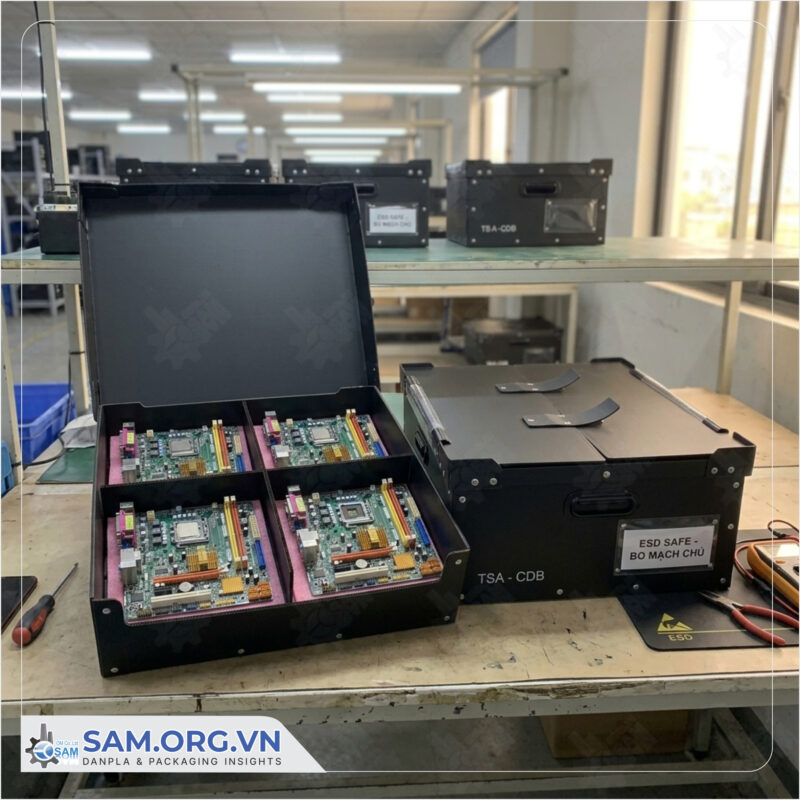
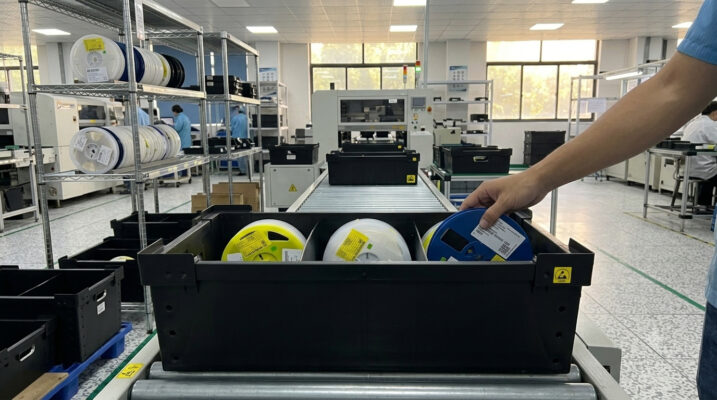
ESD Danpla boxes are made from PP sheet blended with a special conductive additive. Surface resistivity is controlled within the ESD range to protect sensitive components. ESD boxes are identifiable by their characteristic black color and the ESD symbol printed on the side panel.
Environments where ESD boxes are mandatory include SMT and PCB assembly lines, semiconductor component warehouses, and final QC inspection stations. For production stages that do not involve static-sensitive parts, standard Danpla boxes are sufficient and more cost-effective.
A common factory mistake is mixing ESD and standard boxes without a clear identification system. Color-coding at the procurement stage prevents mix-ups without requiring additional floor signage.
Combining ESD Boxes with ESD Partitions
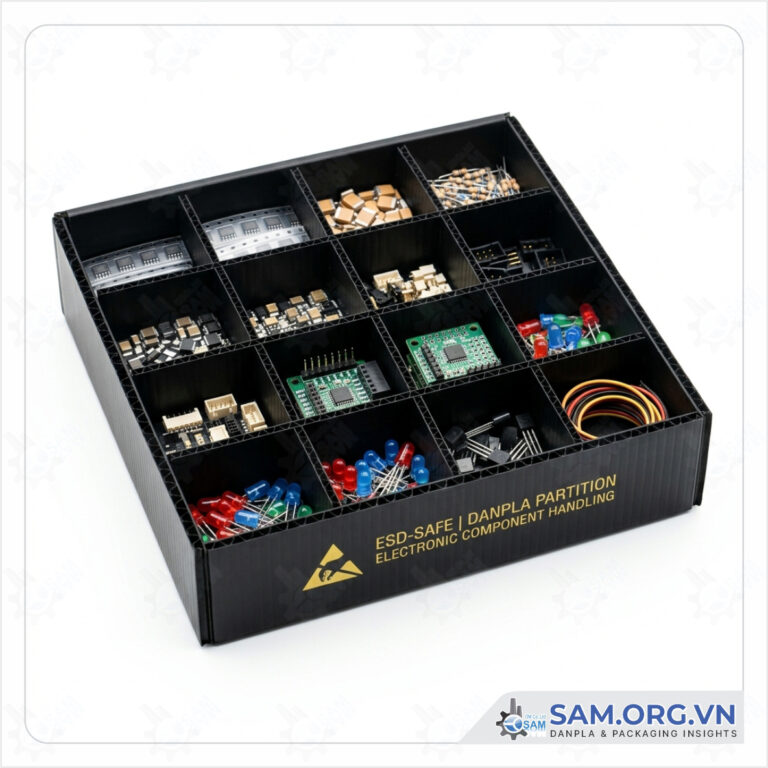
ESD boxes are typically paired with ESD partitions inside to divide components into individual slots. Partitions prevent components from colliding during transport and allow quick counting when the box is opened at the SMT station.
SAM manufactures both ESD boxes and ESD partitions to the same technical specifications. The clearance between partition and box wall is controlled to drawing so components do not jam. Handles and corner clips can be added to improve stacking stability and ease of handling.
The number and layout of partitions are customized per component type. Moreover, the same box size can accommodate different partition configurations for different SKUs. For technical details on ESD partitions, see the article ESD Corrugated Plastic Partitions Explained.
Need technical advice tailored to your production line? Contact SAM’s engineering team — free, no obligation: +84 363 939 228 (Mr. Đạt)
Real-World Applications in Vietnam’s Electronics Factories
Internal Component Circulation
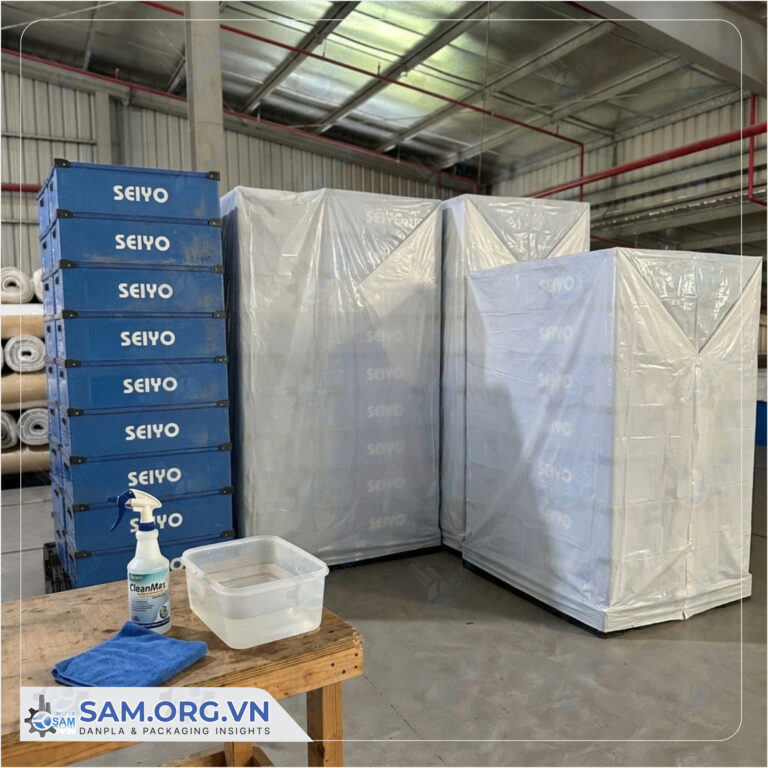
In electronics factories, components move between workstations many times per shift. Boxes must be light enough for manual handling, strong enough for multi-level stacking, and foldable when empty so return conveyors stay clear.
Japanese and Korean FDI factories in Vietnam typically require standardized box systems: consistent colors and dimensions matched to their pallets and internal racks. SAM accepts bulk orders from several hundred boxes upward, delivered in batches aligned with the factory’s project timeline.
In addition, Danpla boxes work well with AGV systems and automated conveyors in next-generation electronics plants. Box dimensions are designed to align precisely with automated stations, reducing positioning errors when robots handle the loads.
For a broader view of Danpla applications in the electronics sector, see Applications of Corrugated Plastic Sheets in the Electronics and Logistics Industries.
Export Packaging for Components and Finished Goods
When electronic components and finished goods ship to Japan, the United States, or the EU, packaging requirements rise: no loose particles, no dust, no static, and low weight to reduce air freight costs.
Virgin PP sheet produces no paper dust and does not absorb moisture inside a shipping container. SAM prints UV-resistant barcodes and QR codes directly on the box or supplies separate peel-and-stick labels to meet lot traceability requirements for each export shipment.
ISO 9001:2015 and ISO 14001:2015 certifications from TQC (valid through January 14, 2028), along with SGS certification, support vendor qualification at major overseas electronics groups. SAM currently serves 300+ customers across 15+ markets, including Japan, the United States, and Australia.
Furthermore, for export orders SAM can co-design a complete packaging solution — Danpla outer box combined with EVA or PE foam inner lining. As a result, electronics factories can shorten their packaging supply chain instead of sourcing from multiple suppliers.
Frequently Asked Questions about Corrugated Plastic Boxes for Electronics
Can corrugated plastic boxes be folded flat for storage and return logistics?
Yes. Danpla boxes are designed to fold completely flat when empty. Fold lines and locating grooves are built into the sheet during fabrication. When needed, an operator opens the box and locks the corners with clips or strapping. For empty returns, fold flat and stack — this saves significant floor space compared with solid plastic containers of the same volume.
How are ESD corrugated plastic boxes different from standard ones?
ESD boxes are made from PP sheet blended with a conductive additive, identifiable by their black color and surface resistivity within the ESD range per electronics industry standards. Standard boxes use virgin PP in many colors and have no conductive properties. Choose ESD boxes when the contents are static-sensitive: ICs, semiconductors, PCBs, and sensor modules.
Does SAM supply corrugated plastic boxes in custom sizes?
Yes. SAM produces boxes to the customer’s drawings without requiring existing molds. Customers provide internal dimensions — length, width, height — and sheet thickness. Minimum order quantity and lead time depend on the design complexity. Contact SAM directly for a specific quote and delivery schedule.