VI
VI EN
EN
SMT Components Are Vulnerable to Static Discharge and Humidity
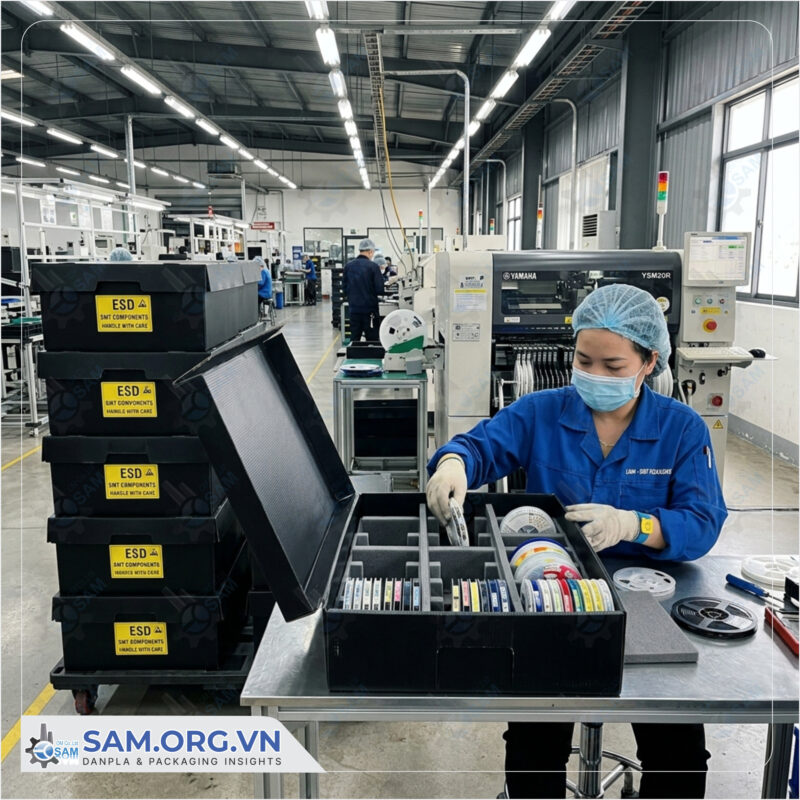
Surface-mount (SMT) components such as ICs, capacitors, and resistors have small bodies and thin solder leads. As a result, they are vulnerable to electrostatic discharge and humidity during internal transport. A standard SMT line typically requires the static charge in the production area to stay below 100V. Therefore, packaging is not just a container. It forms part of the quality control system.
In electronics factories across Vietnam, SMT components move through several stages: warehouse, placement line, inspection, and export packing. Consequently, a packaging mismatch at any stage can cause static discharge that damages components, or moisture that weakens solder adhesion. However, static damage often does not show up under visual inspection. The defect surfaces later during functional testing, when the cost of rework is much higher. This article outlines common SMT component packaging solutions for each stage, and explains why electronics factories choose SAM as a supplier.
When a shipment fails incoming inspection due to static damage, the receiving factory typically holds the entire lot for rework or replacement. This delay can affect downstream assembly schedules, particularly for component types with long lead times. Packaging failures are therefore rarely isolated incidents. Instead, they ripple through the supply chain until the root cause, often a mismatched tray or a missing ESD layer, gets identified and corrected.
Packaging Solutions for Each Stage of SMT Component Handling
SMT component packaging is not a single product. Instead, it is a set of protective layers matched to each stage, from the initial tray to the moisture barrier bag used at shipping. Each layer must meet its own requirement for static control, moisture control, or shock absorption.
ESD Trays and Dividers Made of Danpla Sheet
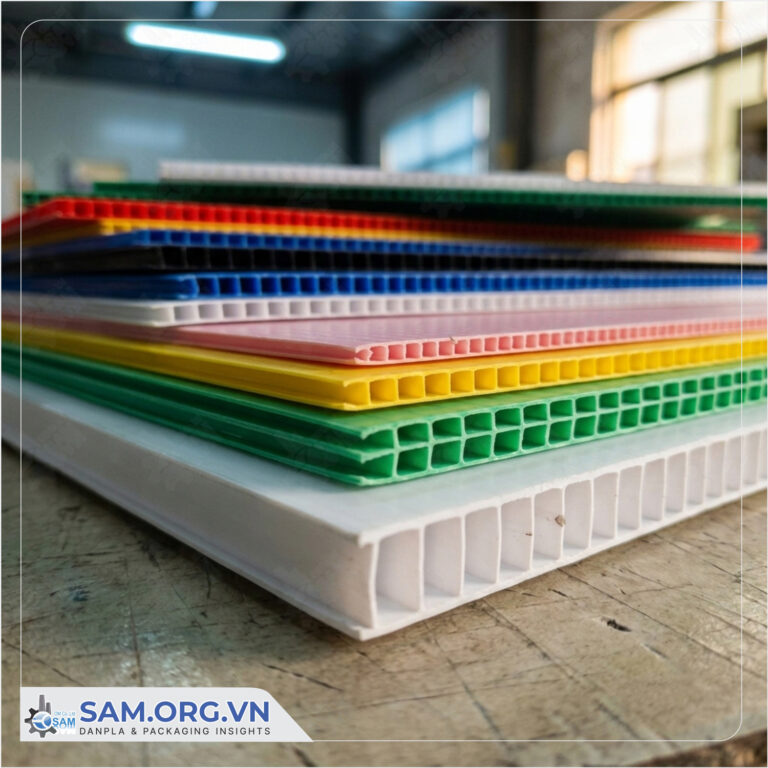
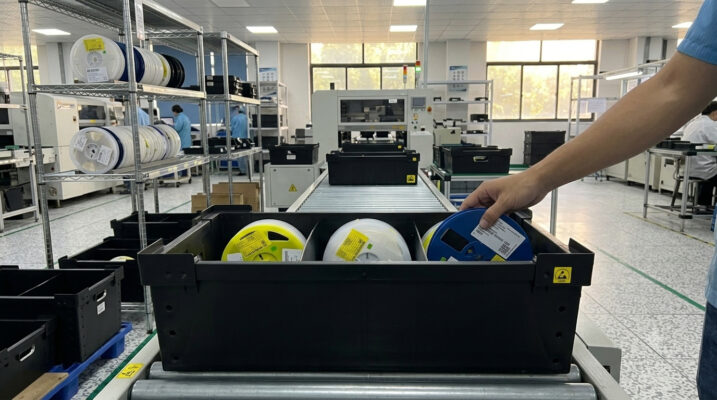
Trays for SMT components typically use Danpla sheet blended with conductive additives, reaching surface resistance within the antistatic range. SAM manufactures Danpla sheet from 2 to 10mm thick, up to 1200mm wide, and die-cuts it into trays and dividers sized to each customer’s component tray. For sensitive parts such as SOP or QFP packages, ESD Danpla partitions hold each component in a fixed position, therefore preventing lead damage from contact during transport.
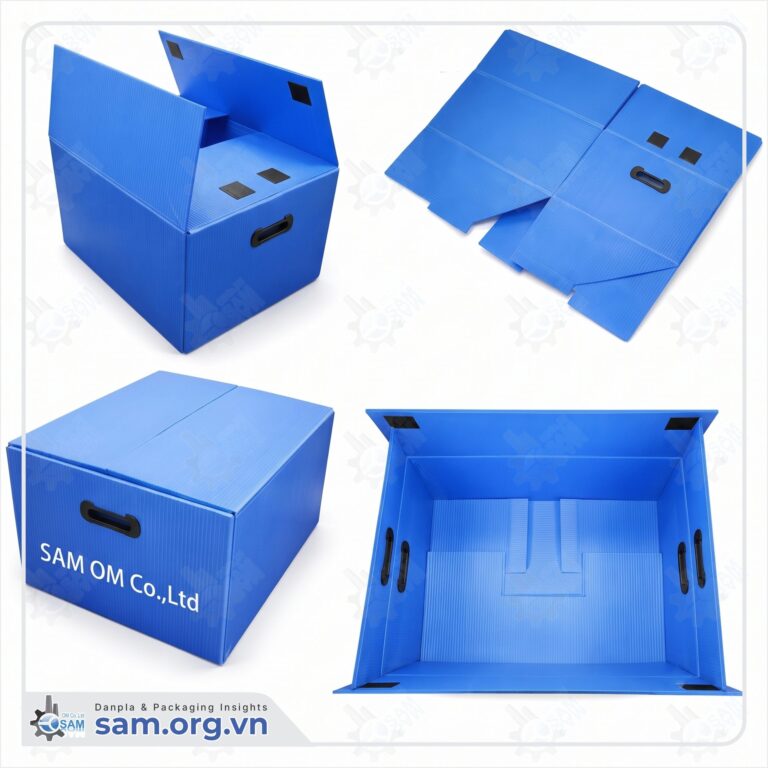
In addition, the honeycomb structure of Danpla sheet is lighter yet stronger than cardboard at the same thickness. Beside individual trays, Danpla boxes for the electronics industry gather several small trays together, so warehouse staff can move stock between storage and the SMT line without repacking into cardboard each time.
Moisture Barrier Bags, Shock-Absorbing Foam, and Traceability Labels
For components stored long-term or shipped for export, a moisture barrier bag combined with a desiccant pack keeps internal humidity within a safe range for solder joints. EVA and PE foam is die-cut to match the tray shape and placed between tray layers to reduce vibration during truck or container transport.
Moreover, barcode or QR labels on each tray let the factory trace batch numbers, production dates, and component specifications. As a result, operators do not need to open the packaging for a visual check, which reduces the number of handling steps that carry static risk. For custom orders, SAM prints labels directly on the divider or box, so warehouse staff can sort stock faster without an extra loose label.
Selecting the right combination of tray, divider, foam, and label depends on the component sensitivity class and the shipping distance involved. A locally distributed component with a short transport time may only need a basic ESD tray. An export shipment crossing multiple carriers, however, benefits from the full combination: a moisture barrier bag, foam cushioning, and a traceable label on the outer box.
Real-World Use on the SMT Line and Export Logistics
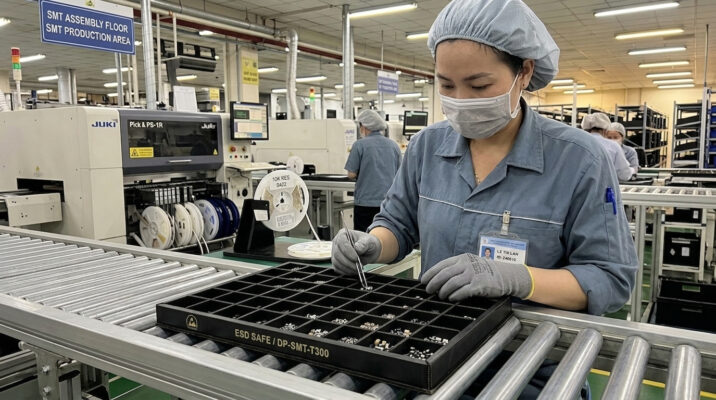
On an SMT line, component trays travel through several stations: the pick-and-place feeder, the reflow oven, the AOI inspection station, and final packing. At each station, operators handle the trays directly, so packaging must be both antistatic and easy to handle with one hand. Because these stations run continuously, any packaging that requires two-handed unwrapping slows the entire line down. For factories exporting to the US, Japan, or Australia, packaging must also meet additional requirements for sea or air freight.
Danpla Trays Compared with Pre-Molded Plastic Trays
Pre-molded ABS trays offer high dimensional precision, but tooling costs run high and are hard to adjust when a component model changes. Danpla trays and dividers, on the other hand, are die-cut to order and require no mold. Consequently, this approach suits SMT factories that change part numbers frequently or run small to medium volumes, cutting the wait time whenever a new component generation launches.
Beyond tooling cost, pre-molded trays also require minimum order quantities that can exceed what a mid-size SMT factory needs for a single production run. Danpla trays, by contrast, scale down to smaller batches without a large cost penalty. This makes the material a practical fit for factories running frequent engineering changes, where committing to a fixed mold would tie up capital unnecessarily.
For export shipments, an outer Danpla box nested around the trays acts as a second layer of protection. It withstands stacking inside a container without an extra layer of cardboard, which reduces the packaging steps needed before each shipment. For factories running mixed export lanes, this consistency also simplifies freight forwarder handling instructions across shipments.
Need technical advice tailored to your production line? Contact SAM’s engineering team — free, no obligation: +84 363 939 228 (Mr. Đạt)
Why Electronics Factories Choose SAM for SMT Component Packaging
SAM has manufactured industrial packaging since 2010 and now serves more than 300 customers across 15 export markets, including the US, Japan, Australia, the UK, and Russia. The factory runs 6 production lines across 5,000 square meters, with a capacity of over 150 tons of material per month, therefore covering large tray and divider orders for SMT factories with multiple product lines. This scale lets the factory maintain consistent lead times even when several customers place large orders within the same month.
In addition, the quality management system holds ISO 9001:2015 and ISO 14001:2015 certification, alongside SGS assessment. As a result, electronics customers can add Danpla packaging to their supplier control process without an extra audit. SAM’s Danpla sheet uses 100% virgin PP resin and comes in more than 20 colors, which helps sort trays by component line or inspection status.
Beyond raw capacity, SAM’s engineering team works directly with customers during the design stage, reviewing tray drawings before cutting begins. This step catches dimensional mismatches early, before a full production run is committed. For SMT factories introducing a new component package, this collaborative review often shortens the time between design approval and first delivery.
SAM also ranks in the VPA Top 100 industrial packaging suppliers, a reference point procurement teams often check when qualifying a new supplier. It also gives buyers a quick way to benchmark SAM against other packaging vendors during the sourcing process.
Frequently Asked Questions
What static control standard should SMT component packaging meet?
A standard SMT work area typically requires static charge to stay below 100V. Therefore, SAM’s ESD Danpla trays and dividers use conductive additives that reach a surface resistance within the antistatic range for this threshold.
Can Danpla trays and boxes be reused multiple times?
Yes. The honeycomb structure of Danpla sheet resists moisture and holds up under repeated handling better than cardboard. As a result, factories commonly reuse trays and boxes across several internal transport cycles before replacement.
Does SAM produce trays and dividers in custom sizes?
Yes. SAM die-cuts Danpla sheet from 2 to 10mm thick according to each customer’s tray drawing, without requiring a mold like pre-molded plastic trays. This suits SMT factories that change part numbers often.
How long does delivery take for an SMT packaging order?
Lead time depends on order quantity, tray design complexity, and material availability at the time of order.
Most SMT packaging orders move from drawing approval to first delivery within a few weeks, though larger custom tooling runs may take longer depending on order volume.