VI
VI EN
EN
Why plants in Hai Phong need corrugated plastic partitions
Hai Phong is the largest manufacturing and seaport hub in northern Vietnam. Industrial parks such as DEEP C, VSIP and Trang Due host many electronics, mechanical and logistics plants. Therefore, these plants need a reliable way to protect parts during storage and internal transfer.
Danpla plastic partitions are a familiar answer to this problem. In short, each divider splits a box into separate cells. As a result, every part sits in its own cell. Moreover, the parts do not knock against each other when a forklift moves the box.
Damage cost is the deeper reason. For example, one chip that fails from static drags along test and rework cost. Likewise, a scratched machined part must be reground or scrapped. Therefore, partitions block these risks right at the transfer stage.
Demand in Hai Phong also comes from timing. Plants run on tight delivery schedules. Because of this, a nearby supply source shortens the order and receipt time. In this article, we explain the structure, uses and selection of Danpla partitions for factories in Hai Phong.
What corrugated plastic partitions are and how they are built
Fluted core and thickness
Danpla partitions use PP plastic in a hollow fluted sheet. The structure has two flat skins and vertical flutes in between. Therefore, the sheet stays light yet resists compression well.
Common thickness ranges from 2 to 10mm. For example, thin 2 to 4mm sheets suit light cell dividers. In contrast, thick 5 to 10mm sheets suit load-bearing cells or tall walls. In addition, the workshop cuts and creases the sheet to fit each box size.
Virgin PP does not absorb moisture, and it does not rot like paper. As a result, the partition washes with water and reuses many times. This is a major difference from single-use carton dividers.
Compared with carton and wood dividers
Compared with a carton divider, Danpla weighs about the same but lasts far longer. Carton goes soft in humidity, and it tears after a few uses. In contrast, Danpla keeps its shape across many transfer cycles.
Compared with wood or acrylic, Danpla is lighter and easier to fabricate. Wood is heavy, cracks and can shed dust. Acrylic is rigid but brittle and costly. Therefore, the cost per cycle of Danpla is usually the lowest on repeat orders.
Standard grade and antistatic ESD grade
Danpla partitions come in two main groups. The standard grade suits mechanical parts, plastic goods and consumer items. However, the antistatic grade adds an ESD compound, so it suits circuit boards and electronic parts.
For more detail, see our guide on ESD corrugated plastic partitions. For electronics plants in Hai Phong, the ESD grade is almost a must. Static charge can ruin a chip that the eye cannot see.
Spotting the ESD grade is fairly simple. Usually, the antistatic sheet has a distinctive black color. Its surface gives a resistance value in the static-dissipative range. Therefore, when in doubt, ask the supplier to send the measured data with the batch.
Uses of Corrugated Plastic partitions in Hai Phong plants
Partitions appear across many sectors in the city. In each case, the goal is the same: keep parts apart and protect surfaces. However, the grade and thickness change with the goods. Below are the most common uses in local plants.
Electronics and components
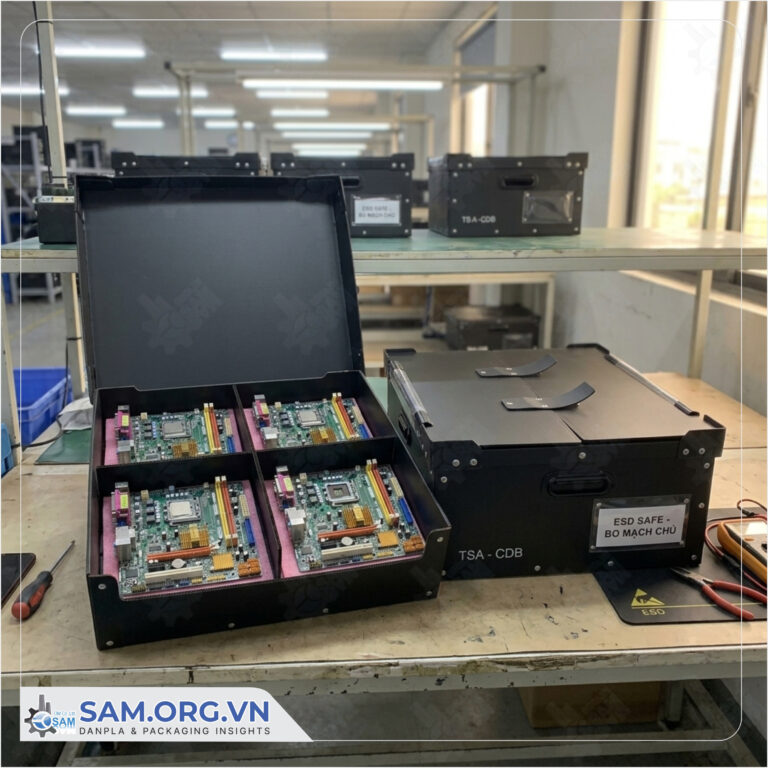
Electronics plants in Hai Phong handle many small parts. For example, boards, connectors and precision assemblies all scratch easily. Therefore, partitions split a box into a matrix of square cells. As a result, each cell holds one part and prevents shifting between steps.
A common example is a box split into 20 cells. In this layout, 5 rows by 4 columns keep 20 connectors apart. Therefore, a worker picks and places each part without touching the next one. As a result, the risk of drops and scratches falls during handling.
For static-sensitive goods, an ESD partition drains charge to ground safely. Because of this, the hidden defect rate on boards drops. In addition, many SMT lines use boxes with fixed partitions to carry work in progress through each station.
Mechanical, plastic and warehousing
The mechanical sector uses partitions to separate metal parts. As a result, this avoids impact that dents or scratches a machined surface. Moreover, a thick 5 to 10mm sheet holds heavy parts without collapsing.
Injection shops also use partitions to stack parts that are still warm. In this case, separate cells stop parts from sticking or deforming together. In addition, the smooth Danpla surface leaves few marks on the product.
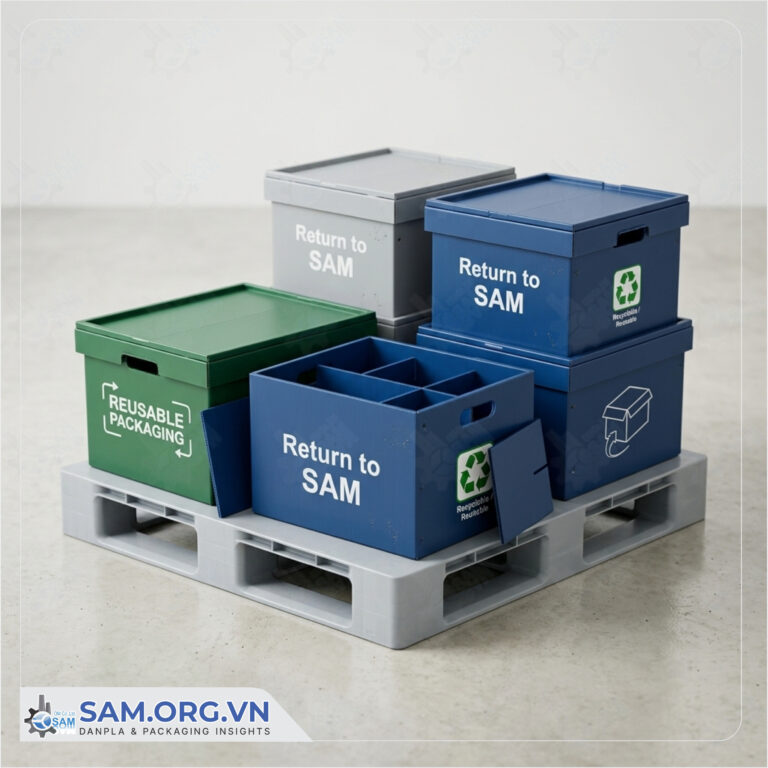
In warehousing, partitions keep goods tidy and speed up counting. In fact, each cell is a clear counting unit. Therefore, companies often pair partitions with Corrugated plastic boxes in Hai Phong to form a closed returnable set.
Export packing through Hai Phong port
Hai Phong has a major seaport, so many plants ship goods directly. Therefore, Danpla partitions hold products firmly inside a container over a long voyage. As a result, motion at sea does not throw parts against each other.
Moreover, PP material handles humidity swings inside a container. Paper softens and loses structure when it meets moisture. In contrast, a Danpla partition keeps its shape, so goods arrive in safer condition.
Layer pads and trays in a pallet
Beyond vertical walls, Danpla also serves as a horizontal layer pad. In this role, the pad sits between stacked tiers on a pallet. As a result, the upper tier does not press directly on the lower one.
Moreover, a Danpla tray keeps groups of parts together in a cluster. Therefore, teams load faster and count by layer. For goods exported through Hai Phong port, a layer pad reduces crushing under a tall stack.
In addition, a pad and a partition often work as one set. The walls hold parts sideways, and the pad separates the tiers. Together, they turn a plain box into a structured, reusable carrier.
Need partition specs tailored to your production line? Contact SAM’s engineering team in Hai Phong, free and with no obligation: +84 363 939 228 (Mr. Đạt)
How to choose the right corrugated plastic partition
Set thickness by load
First, weigh the part that sits in each cell. For light parts under one kilogram, a 2 to 4mm sheet is enough. However, heavier parts or tall walls need a 5 to 10mm sheet.
Wall height also affects the stiffness you need. In general, a taller wall bends more easily when the sheet is thin. Therefore, when in doubt, pick one grade thicker to stay safe.
- 2mm to 3mm: cell dividers for light parts, labels and small accessories.
- 4mm to 5mm: general partitions for electronics and plastic goods.
- 6mm to 8mm: medium load cells and mid-size mechanical parts.
- 9mm to 10mm: tall walls and cells for heavy metal parts.
Choose by environment and goods
Static-sensitive electronics must use an ESD partition. In contrast, ordinary mechanical goods can use the standard grade to save cost. Furthermore, a damp or oily environment favors Danpla, because PP sheets shed water and wipe clean easily.
Color is another criterion. For example, there are more than 20 colors to sort goods or process stages. Moreover, if you want to match a larger packaging system, consider custom-cut Corrugated plastic partitions and boxes. Size, cell count and thickness all follow the factory drawing.
Work out the lifecycle cost
A carton divider is cheap to buy but lasts one trip. In contrast, a Danpla partition costs more upfront but spreads over many cycles. Therefore, on a repeat route between two plants, the cost per trip falls quickly after a few dozen cycles.
You should count by the total expected cycles, not the upfront price. As a result, this figure reflects the true packaging cost. In addition, the engineering team can help estimate cycles based on your transfer route.
How to choose a corrugated plastic partition supplier in Hai Phong
The deciding factor is custom fabrication capacity. Each plant has a different box size and cell count. Therefore, the supplier must cut, crease and assemble partitions exactly to the drawing. Even a few millimeters of error can make a partition miss the box.
The order process should start with a drawing or a real box sample. From there, the workshop builds a partition sample and sends it for approval before the run. As a result, this sample step avoids errors once mass production begins.
For a fast quote, you should prepare the following details in advance:
- The inside dimensions of the box that holds the partition.
- The cell count with the row and column layout.
- The weight and size of the part in each cell.
- The grade you need: standard or antistatic ESD.
- The expected volume and the number of transfer cycles.
SAM has manufactured Danpla since 2010, and it now serves more than 300 customers across over 15 export markets. In addition, a capacity of 150+ tons per month on 6 lines covers both large and rush orders. The plant holds ISO 9001:2015 and ISO 14001:2015, along with SGS certification.
For a B2B buyer, certification is more than paperwork. For example, ISO 9001:2015 shows steady quality control across batches. Moreover, ISO 14001:2015 shows an environmental commitment, which matters more and more in export supply chains.
For customers in Hai Phong, domestic production shortens lead time and cuts freight cost. For example, electronics customers such as Canon and LG show that the material meets strict standards. Moreover, the engineering team helps you pick thickness, ESD grade and cell layout from the drawing stage.
Frequently asked questions
Can corrugated plastic partitions ship quickly in Hai Phong?
Yes. Because production is domestic, custom-size partitions are cut and delivered in a short time. In addition, rush or large orders run on 6 lines in parallel. However, the exact time depends on cell count and thickness.
How do standard and ESD partitions differ?
The standard grade does not conduct, so it suits mechanical and consumer goods. In contrast, the ESD grade adds an antistatic compound and drains charge to ground to protect boards. Therefore, electronics plants in Hai Phong should use the ESD grade for sensitive parts.
How many times can corrugated plastic partitions be reused?
PP plastic is durable and does not rot, so the partition reuses many times. Moreover, after each cycle you only wipe or rinse it with water. In practice, the life depends on load and care, but it far exceeds a carton divider.
What affects the price of corrugated plastic partitions?
Price depends on thickness, size, cell count and the standard or ESD grade. In addition, order quantity affects the unit price. Therefore, to get an exact figure, send a drawing or box size for a quote.