VI
VI EN
EN
Why Proper Maintenance of Corrugated Plastic Boxes Matters
Corrugated Plastic Boxes are made from 100% virgin polypropylene, a material engineered for multiple reuse cycles in internal transport and inter-warehouse logistics. However, that advantage only holds when operators follow a consistent maintenance routine after each cycle. Two factories using identical boxes can achieve very different service lifespans. The difference comes down to cleaning practices and daily storage conditions — not product quality at the point of manufacture.
Moreover, proper maintenance directly reduces cost per cycle. When a box completes its expected number of trips, the amortized cost per shipment drops well below that of single-use corrugated cartons. This guide provides step-by-step technical instructions that warehouse teams can implement immediately.
Common Factors That Shorten Corrugated Plastic Box Lifespan
Four factors most frequently reduce service life:
- Industrial oils and grease accumulating over time and penetrating the PP sheet structure.
- Prolonged direct UV exposure, which causes brittleness and surface discoloration.
- Incorrect stacking that creates permanent deformation at corners and panel edges.
- High-concentration cleaning agents that cause micro-cracking and damage printed surfaces.
Corrugated Plastic Box Cleaning Procedure
Post-Cycle Cleaning Routine
After boxes return from the production line or an external warehouse, follow this three-step sequence.
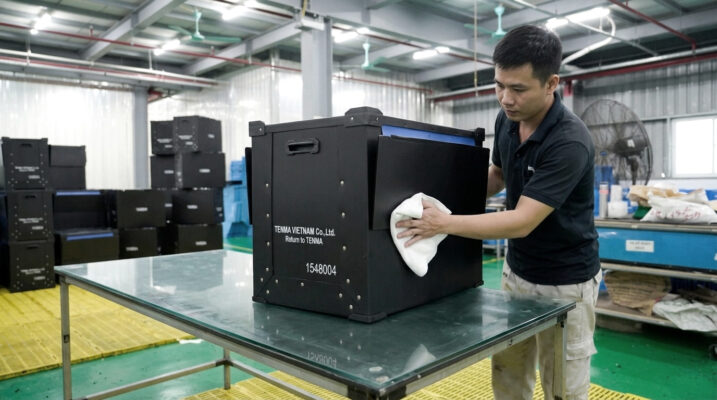
Step 1: Stand the box upright and tap the walls lightly to dislodge large debris inside. For flat-fold boxes, open the box fully before cleaning to reach all inner surfaces.
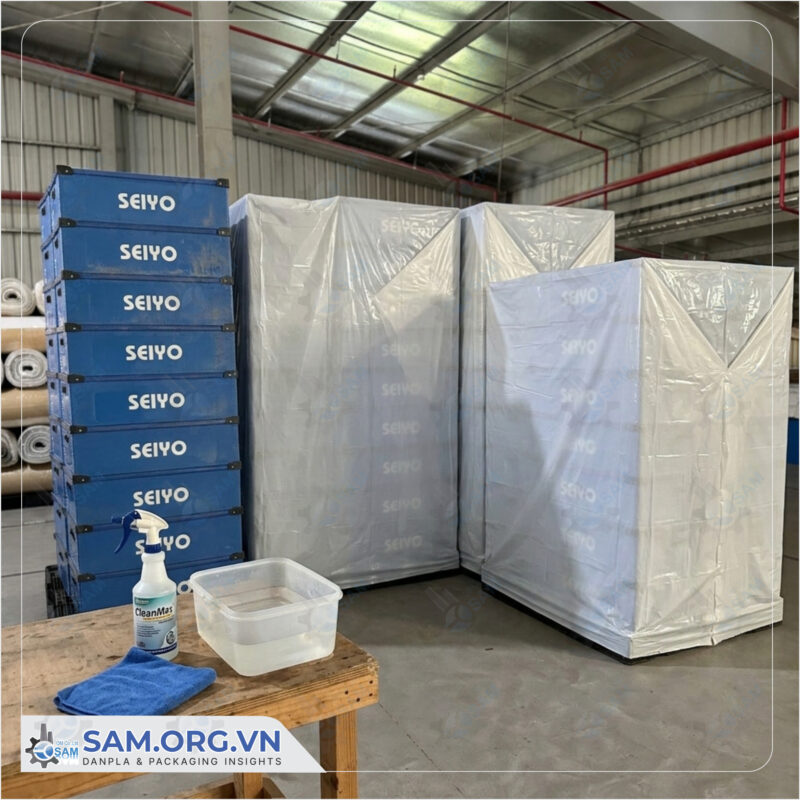
Step 2: Use a soft microfiber cloth or sponge. Wipe all inner and outer surfaces with clean water. For ordinary soiling, prepare a 1-2% neutral detergent solution, wipe thoroughly, and rinse with clean water. Do not allow detergent to dry on the surface, as it leaves residue that is harder to remove in subsequent cycles.
Step 3: Dry completely with a clean cloth or allow to air-dry in a ventilated space. Do not stack boxes for storage while they are still damp. The enclosed environment between stacked boxes promotes bacterial growth when moisture is present.
Three things to avoid: high-pressure spray nozzles directed at corner joints (causes delamination); prolonged soaking in water; and stiff brushes on printed surfaces (causes ink fading).
Industry-Specific Cleaning Requirements
Food and pharmaceutical industries require stricter hygiene standards. For organic contamination such as food liquids, animal fat, or fermentation residue, use a mild alkaline solution at pH 8-10. Rinse multiple times with clean water and allow complete drying before reuse. In addition, avoid high-concentration chlorine-based cleaners, as these can damage printed surfaces.
Electronics industry: for ESD-rated Danpla boxes, measure surface resistance after every 20 cleaning cycles using equipment calibrated to ANSI/ESD S7.1. Furthermore, avoid high-concentration alcohol solvents. Alcohol degrades the ESD surface layer, causing the box to fall below the resistance specification required to protect sensitive components.
Light chemical industry: PP plastic is compatible with dilute acids, mild alkalis, and vegetable oils. However, PP is not compatible with aromatic hydrocarbons or halogenated solvents. Therefore, always check the material compatibility chart from your chemical supplier before selecting a new cleaning agent.
For export logistics applications, clean all outer surfaces before loading. This requirement is mandatory under the phytosanitary regulations of several key import markets, including Australia and Japan.
Storage Conditions for Corrugated Plastic Boxes
Warehouse Environment
The safe storage temperature range for PP plastic is 5-40°C. Avoid leaving boxes in parked trucks during summer. Temperatures inside a container or truck under direct sunlight can exceed 60°C and cause permanent deformation at corners and fold lines. If refrigerated storage is unavailable, prioritize covered, well-ventilated areas.
Regarding light exposure: cover boxes with tarps or store in a roofed facility. PP has moderate UV resistance, but continuous direct sunlight for more than six months causes brittleness and surface discoloration. Boxes that become brittle from UV exposure tend to crack suddenly under load without prior visible warning signs.
Regarding floor contact: place boxes on pallets or metal racking. Do not store directly on damp concrete floors. Damp concrete combined with day-night temperature fluctuations generates condensation inside the boxes. Although PP does not absorb moisture, high humidity combined with dust provides conditions for bacteria and mold to develop on interior walls during long-term storage.
Stacking and Warehouse Organization
Danpla boxes are designed to be stacked when empty. Observe load limits to prevent deformation of lower layers. For medium-sized boxes with 3-5mm sheet thickness, do not exceed 8-10 layers. Boxes with 2mm sheet thickness or larger footprints should be limited to 6-8 layers.
For flat-fold boxes: stack horizontally on pallets and secure with strapping to prevent toppling. Do not place heavy objects on top of flat-stacked piles. Apply the FIFO principle — first in, first out — to ensure no batch sits under static load for an extended period.
For boxes fitted with box accessories such as divider bars, square corners, swivel corners, or handles: disassemble before storing. Keep accessories in zip-lock bags or small trays placed next to the box batch. This prevents loss of small components and eliminates uneven pressure points when stacking.
Need technical advice tailored to your production line? Contact SAM’s engineering team — free, no obligation: +84 363 939 228 (Mr. Đạt)
Periodic Inspection and Replacement Decisions
Inspect boxes every three months or after every 50 use cycles. Four checkpoints determine whether a box continues in service or is retired:
Key Damage Indicators
Corner structure: press gently on each corner. A cracking sound or layer separation indicates the box has lost structural integrity at that joint. As a result, the box should not be used for heavy loads — sudden failure during transport can damage contents.
PP sheet surface: distinguish between two damage types. Surface scratches are cosmetic and do not affect structural performance. Micro-cracks, however, are fine cracks typically 1-5cm long that run partway or fully through the sheet thickness. Micro-cracks indicate material fatigue and cannot be repaired.
Fold-line wear: foldable Danpla boxes develop wear marks at fold points after repeated opening and closing. When a fold line turns white and rigid, the box is approaching failure at that location on the next fold cycle.
Base and load capacity: boxes with a sagging base or misaligned corners should not carry heavy loads. Either reduce the load weight or reassign the box to light-duty internal transport. Danpla scrap (virgin PP) is 100% recyclable. Contact a local PP plastic recycler to dispose of retired boxes in compliance with environmental regulations.
Boxes that retain structural integrity but fail cosmetic standards due to surface scratches or fading can be reassigned to internal warehouse use. This approach extends the useful life of each box and reduces total replacement spend. For reference, see how businesses manage the full lifecycle of reusable corrugated plastic boxes.
Frequently Asked Questions About Corrugated Plastic Box Maintenance
Can I use alcohol to clean corrugated plastic boxes?
70% isopropyl alcohol is acceptable for standard wiping. PP plastic is not immediately damaged at this concentration. However, prolonged soaking or repeated use of 90%+ alcohol will dull printed surfaces and may cause micro-cracking over time. For ESD-rated boxes, avoid alcohol entirely. The ESD surface layer is sensitive to organic solvents and may lose its protective effectiveness for sensitive electronics.
How many cycles can a corrugated plastic box complete before replacement?
There is no fixed cycle count. Service life depends on three factors: the type and weight of goods transported, actual handling practices in the warehouse, and storage conditions between cycles. In practice, boxes that are cleaned correctly, stored at 5-40°C, and not overloaded can remain in good condition for many years of operation. Therefore, assess boxes based on physical inspection criteria rather than tracking cycle counts. For additional context, see how logistics operators use Corrugated plastic boxes for logistics.
Can corrugated plastic boxes be washed in an industrial washing machine?
Yes, provided two conditions are met: water temperature does not exceed 60°C, and no strong alkaline chemicals above pH 12 are used. The conveyor must support boxes in the correct orientation to prevent deformation during the wash cycle. Set conveyor speed to medium so boxes are cleaned thoroughly without hard impacts. After machine washing, inspect corner joints and fold lines before returning boxes to service.