VI
 EN

Why chemical plants need corrosion-resistant materials
Factories that handle chemicals face a specific materials problem. Acids, alkalis, oils, solvents and moisture attack surfaces on every shift. As a result, cardboard boxes break down quickly, while metal containers rust and conduct electricity. Therefore, technical buyers need a material that is both chemically inert and electrically safe.
Corrugated plastic, also known as Danpla, coroplast, correx or corflute, is a hollow-core fluted PP sheet that meets both needs. Polypropylene is chemically inert, so it does not react with most industrial acids, alkalis and salts. In addition, PP is a strong electrical insulator. Consequently, corrugated plastic sheets work well as partitions, trays and liners in zones with corrosion or electrical risk.
This article explains the material basis of both properties. Moreover, it covers the usage limits and how to pick the right sheet for each factory zone.
Chemical resistance of PP corrugated plastic
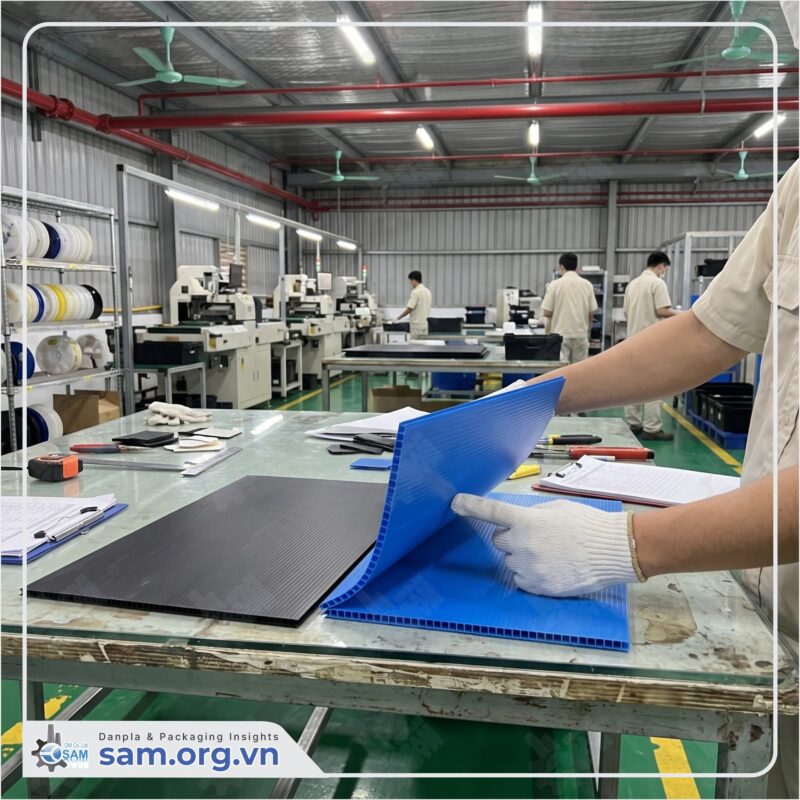
Chemical resistance is a core property of PP, rather than an added coating. The molecular structure of PP has few reactive groups, so solutions attack it slowly. As a result, the sheet keeps its shape and stiffness when it meets wastewater, cleaning fluids or chemical vapor.
Chemicals PP handles well
For example, the material resists dilute acids and many concentrated acids across a range of strengths. In addition, it stays inert against alkalis such as caustic soda and against inorganic salts. Oils, greases and many water-based cleaners do not swell PP. Because the material does not absorb water, liquid does not soak into the fluted core. Therefore, the surface wipes clean and dries fast. In wash-down and wastewater zones, the sheet lasts far longer than cardboard. For this reason, many plants use PP to line work floors and to screen mixing areas.
- Dilute inorganic acids such as HCl and dilute H2SO4 at room temperature.
- Alkaline solutions such as NaOH and KOH at industrial strengths.
- Inorganic salts, brine and many electrolyte solutions.
- Oils, greases and most water-based cleaning fluids.
- Alcohols and some mildly polar solvents.
Compared with other materials, the strength of PP is that it stays stable against several chemical groups at once. Pressed wood, by contrast, absorbs moisture and rots. Metal, meanwhile, rusts when it meets acids and salts. The PP sheet avoids both problems. As a result, one sheet grade can serve several chemical zones in the same plant.
Limits to keep in mind
However, PP does not resist every chemical. For instance, strong aromatic hydrocarbon solvents and strong oxidizers can soften or embrittle the material over time. Moreover, high heat lowers its chemical resistance. PP works reliably from about minus 20 up to roughly 70 degrees Celsius. Beyond that range, both stiffness and inertness drop. Therefore, before using it with a specific chemical, you should send a sample fluid for a soak test. In this way, you can confirm the real service life under actual conditions.
- Aromatic hydrocarbon solvents such as toluene and xylene can swell the surface.
- Strong oxidizers such as concentrated nitric acid corrode it over time.
- Sustained temperatures above 70 degrees Celsius reduce stiffness.
- Long, direct UV exposure needs a grade with added UV stabilizer.
Electrical insulation and safety on the floor
Virgin PP is an electrical insulator. In fact, its volume resistivity is very high, around 1 x 10^15 ohm-cm, together with a high breakdown voltage. As a result, a standard corrugated plastic sheet does not carry leakage current. Therefore, it works as an insulating barrier in cabinets, racks and equipment areas.
Insulation versus ESD protection
First, you must separate two opposite needs. Insulation blocks current from passing through. ESD protection, on the other hand, needs controlled charge flow to drain to ground. Therefore, the standard sheet suits the job of separating live circuits and parts. By contrast, zones that assemble ESD-sensitive components need a sheet with conductive additives. A wrong choice causes the opposite result. To understand the difference, you can read our guide on standard versus antistatic corrugated plastic sheets. In any case, the plant should state the required surface resistance before ordering.
Safety gains over metal
Metal walls and trays conduct electricity, so they need careful grounding. In contrast, switching to an insulating sheet lowers the risk of short circuits near exposed live parts. Furthermore, the light material moves easily and does not rust. In places that are both damp and electrified, the mix of insulation and moisture resistance is a clear advantage. Because the sheet does not absorb water, it holds a stable resistance even when the surface is wet.
It also helps to separate two resistance terms when reading specs. Volume resistivity measures how well the sheet blocks current through its thickness. Surface resistance, on the other hand, measures current along the face. Virgin PP is high on both. However, dust and a moisture film on the face can lower surface resistance for a while. Therefore, zones that need strict insulation should be cleaned regularly and kept free of conductive oils. For high-voltage work, moreover, you should state the operating level so the right thickness is chosen.
Need technical advice tailored to your production line? Contact the SAM Packaging engineering team — free, no obligation: +84 363 939 228 (Mr. Đạt)
Factory applications in chemical and electrical zones
Together, these two properties open many specific uses across the plant. The applications below are grouped by production zone.
Containment and anti-corrosion liners
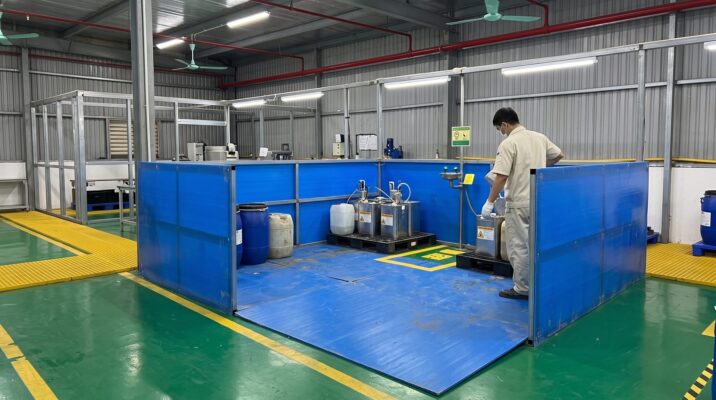
For containment, the sheet forms screens around mixing areas, drip-tray liners and splash guards. Because the surface is inert, it cleans fast between batches. In chemical stores, floor liners and shelf liners stop leaks from soaking into the slab. In addition, waterproof corrugated plastic sheets perform well in damp and frequently washed zones. Furthermore, cut-and-crease fabrication makes each liner fit the tray or rack exactly.
Replacement cost also matters in these zones. A cardboard liner fails after a few spills, so it must be thrown away often. By contrast, an inert PP liner survives repeated wash-downs and stays in service far longer. Therefore, the cost per use drops even though the sheet costs more at first. Over a full year, this gap is often the main reason a plant switches to PP.
Insulation and equipment protection
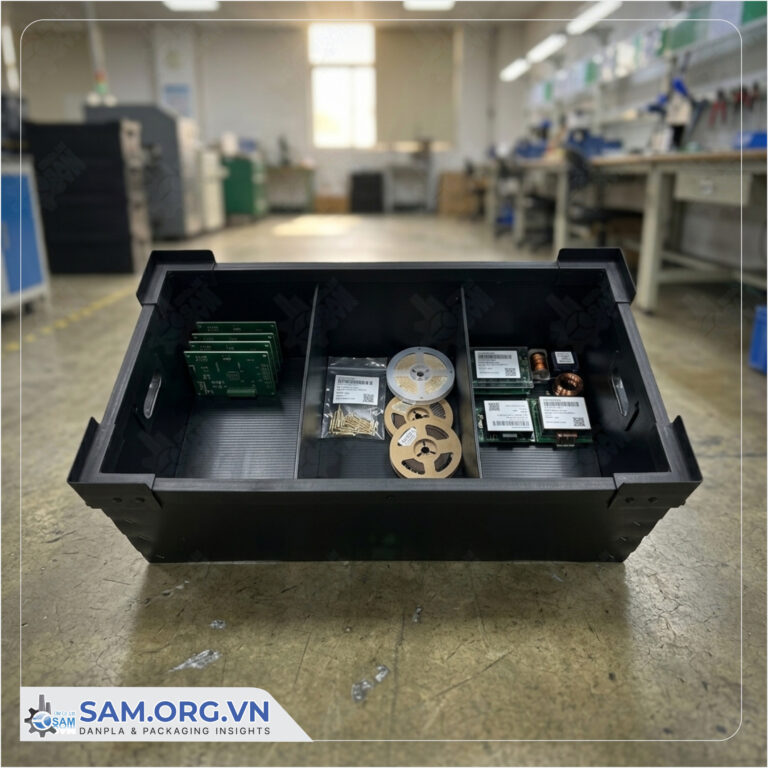
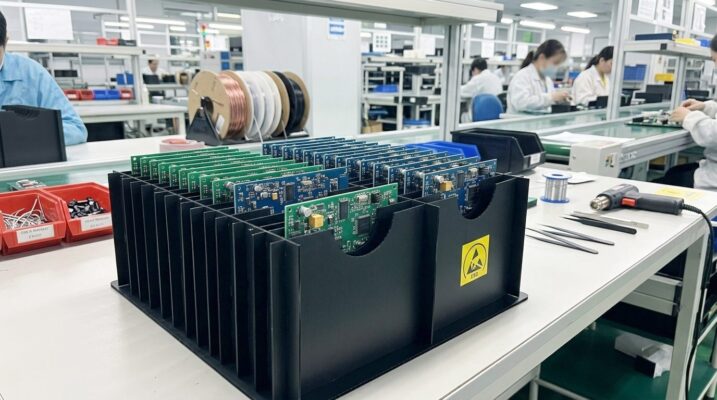
For electrical work, the sheet serves as a partition inside panels, a liner under PCB racks and a shield between live clusters. Because it is light, it fits and removes quickly during maintenance. On assembly lines, it divides part trays and holds components in place during transport. In practice, many industrial applications of corrugated plastic rest on these two properties, namely chemical resistance and insulation. Moreover, sheet color helps sort zones or chemical types.
Examples by industry
In battery and electrochemical plants, the sheet forms tray walls and splash barriers against acid. In plating shops, meanwhile, it lines tanks and screens the plating bath area. Water treatment plants use it as flow baffles and as covers over chemical channels. In cleanrooms, moreover, it makes temporary walls because the surface tolerates strong cleaning fluids. On electronics lines, the insulating grade separates power clusters from PCB racks. Because each industry has its own chemical and electrical needs, the thickness and additive grade should match the real working conditions. For a mixed site, it often helps to standardize on two grades only. One handles general chemical zones, while the other covers insulation. As a result, procurement stays simple and spare stock stays low.
Why factories choose corrugated plastic from SAM
Choosing the right sheet matters more than choosing the lowest price. A sheet with the wrong chemical grade or electrical spec fails early and creates risk. Therefore, SAM produces corrugated plastic from 100% virgin PP, from 2 to 10mm thick, up to 2100mm wide, in more than 20 colors.
Right material grade advice
First, the engineering team asks about the chemical, its concentration, the temperature and the electrical need before quoting specs. For a special chemical, moreover, the plant can send a sample for a soak test. For electrical zones, the insulating grade and the antistatic grade are kept separate. As a result, this approach avoids picking the wrong sheet grade and avoids early failure.
A clear spec also speeds up the quote. In practice, four details cover most cases. First, list the chemicals and their strengths. Second, give the working temperature range. Third, state whether the zone needs insulation or ESD protection. Finally, note the sheet size and the load it must carry. With these four points, the team can propose a thickness and a grade without a long back-and-forth. Therefore, a short spec sheet often saves days on a project.
Quality and delivery capacity
In addition, the products meet ISO 9001:2015 and ISO 14001:2015, with inspection before dispatch. A capacity of more than 150 tons per month across 6 lines covers both large and urgent orders. Furthermore, more than 300 clients at home and abroad already use these sheets and boxes in their plants. Finally, cut-and-crease capability lets each tray and partition arrive at the exact size.
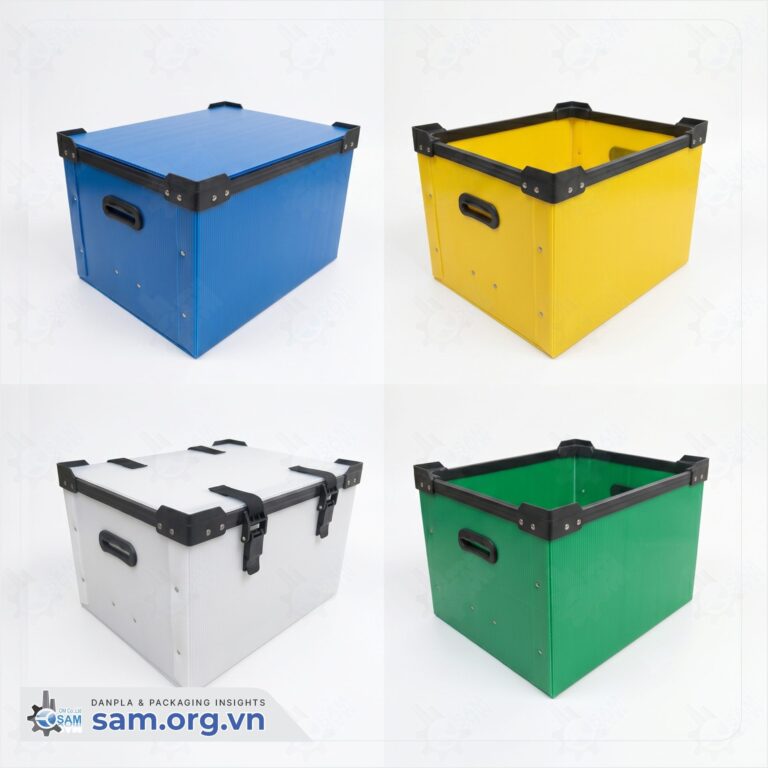
Color and marking options support the same safety goal. For example, one color can mark acid zones while another marks electrical zones. In this way, staff read the hazard at a glance. Moreover, sheets can carry printed labels or warning text where a plant needs them. As a result, the material does more than contain a spill. It also helps the floor team work safely around chemicals and live equipment.
Frequently asked questions
Does corrugated plastic resist acids and alkalis?
Yes, the PP in corrugated plastic resists dilute acids, many concentrated acids, alkalis and salts at normal industrial strengths. However, for strong solvents or strong oxidizers, you should run a sample soak test first. In addition, the working temperature should stay below about 70 degrees Celsius.
Is corrugated plastic an insulator or conductive?
A standard sheet from virgin PP is an insulator, with very high volume resistivity. By contrast, the antistatic (ESD) grade conducts charge in a controlled way. Because the two grades serve opposite goals, you should state the need clearly when ordering.
Can it be used in humid and chemical zones at once?
Yes. Because PP does not absorb water, liquid does not soak into the fluted core. Therefore, the sheet holds its stiffness and its resistance when the surface is damp. As a result, this is an advantage over cardboard and some pressed-wood materials.
Is corrugated plastic the same as Danpla or coroplast?
Yes, they are the same fluted PP product sold under different regional names. The names coroplast, correx and corflute refer to the identical twin-wall sheet in other markets. Therefore, the chemical and electrical properties described here apply to all of these names.