VI
VI EN
EN
Why Correct Corrugated Plastic Fabrication Decides Product Quality
Many factories buy Danpla sheets in large format and cut them in-house. This approach is flexible and cost-effective. However, poor fabrication leaves frayed edges, cracks the flutes, and makes finished boxes fail early.
The material has a hollow fluted core inside. Therefore, cutting or folding across the wrong direction snaps the inner walls. In addition, a score line placed correctly gives a crisp crease. As a result, the part stays strong through many reuse cycles.
This guide covers three core steps: cutting, scoring for folds, and joining. Because each step builds on the last, small mistakes compound quickly. Moreover, doing it right from the first cut cuts waste and speeds up assembly. The content suits production, engineering, and purchasing teams that control quality on the line.
Danpla behaves like a rigid but hollow board. Unlike solid plastic, it has a top face, a bottom face, and vertical ribs between them. Therefore, every cut and fold must respect that internal structure. Once you read the flute direction, the rest of the work becomes predictable.
Cutting Corrugated Plastic Sheets: Match the Tool to Thickness and Volume
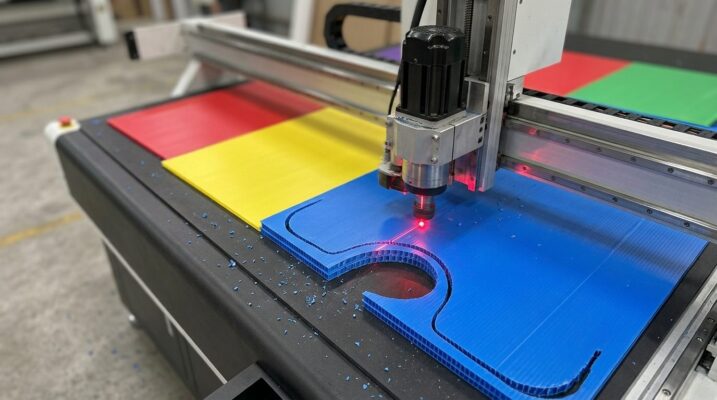
The cut defines edge quality and material waste. Therefore, choose the tool by sheet thickness and order size. For small runs, a utility knife is enough. However, for high volume, a machine gives cleaner and more even edges.
Hand Cutting for Small Runs
Use a sharp utility knife and a steel ruler as a guide. In addition, make several light passes instead of one heavy cut. This method is easy to control, and it keeps edges straight. Because a dull blade drags and crushes flutes, replace it often. For thickness guidance, see our note on how to choose corrugated plastic thickness.
Sheets of 4mm and thicker cut best on a hard flat surface. First, keep the sheet flush to the bench so the flutes do not crush. Then mark the cut line with a pen to hold the exact size. Finally, run the blade lightly along the mark. Clear marking, for example, prevents oversize parts.
Blade Choice and When to Replace It
A hook blade pulls along the flute channel, so it slips less than a straight blade. A straight blade, by contrast, suits short cuts and small details. Hardened steel blades, moreover, hold their edge far longer. Therefore, match the blade to thickness and cutting frequency.
When the edge starts to fray and needs more force, the blade is due for a change. Because a dull blade crushes the flutes, it also bows the edge. In addition, replacing a blade early costs far less than a scrapped blank. As a result, a simple replacement log keeps quality steady.
CNC and Die Cutting for Volume
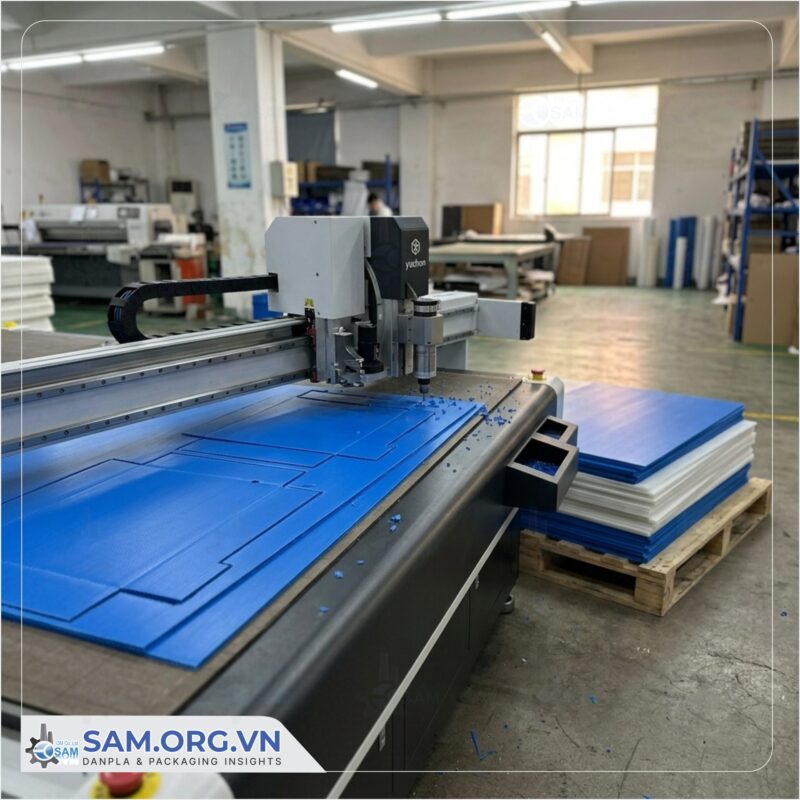
A CNC machine follows a digital drawing with an oscillating or rotary blade. As a result, edges stay sharp and repeat evenly across sheets. Moreover, this method handles complex profiles, rounded corners, and batch holes with ease.
Steel-rule die cutting, for example, cuts the whole shape in a single press. At the same time, the die forms both the score line and the holes. Therefore, it lowers cost per part on large repeat orders. This is how Corrugated plastic sheets become box blanks at scale.
Prepare the Work Surface and Stay Safe
First, cut on a flat mat or bench so the blade tracks evenly. In addition, clamp the sheet so it does not shift mid-cut. For thick sheets, place a backing board underneath to protect the bench. As a result, the edge stays clean and the surface lasts longer.
Moreover, wear gloves and safety glasses when you handle a sharp blade. Collect used blades in a closed box, because loose blades cause cuts. When you cut by machine, keep the area ventilated to clear plastic dust. Therefore, treat safety as part of the process, not an afterthought.
Scoring Fold Lines and Bending Along the Flutes
Folding Danpla differs from folding carton. Because the material has rigid flute walls, it needs a score line for a clean crease. However, a score across the wrong direction cracks the surface. Therefore, finding the flute direction comes first.
Find the Flute Direction First
The flutes run parallel in one fixed direction inside the sheet. Look at the sheet edge, and you will see the open channels. In general, run the fold parallel to the flutes for a clean hinge. Folding across the flutes, by contrast, snaps many inner walls at once. The fluted core is exactly what keeps the sheet light yet strong; see the Corrugated plastic fluted core structure.
Scoring Technique for a Living Hinge
Use a blunt tool to press a groove along the fold line. For example, a scoring wheel or a dull blade both work. Score through one face only, and keep the other face as a hinge. Because scoring too deep cuts both faces, the crease then loses its link. After scoring, fold slowly and firmly along the pressed line. As a result, the crease stays straight and holds its shape.
Allow for Material Thickness at Each Fold
When the sheet folds, the outer face travels farther than the inner face. Therefore, the flat blank must add a small allowance at every crease. A simple rule adds one sheet thickness per fold to the layout. Otherwise, the finished box comes out undersize or oversize.
The safest method, however, folds a test blank and then measures it. Next, adjust the score positions from the real measurement. In addition, record the layout for each product code. As a result, the next run simply reuses a proven flat pattern.
Need technical advice tailored to your production line? Contact SAM’s engineering team, free and with no obligation: +84 363 939 228 (Mr. Đạt)
Drilling, Joining, and Common Mistakes to Avoid
After cutting and folding, most parts need holes and joined edges. This finishing step decides how strong the box or partition is. Therefore, a mistake here wastes the two earlier steps.
Plan the holes and joins before you cut the blank. For example, a hole that lands on a fold line weakens the crease. In addition, mark reference points on the first sample and reuse them. As a result, every later part lines up the same way.
Keep the same reference edge for all measurements. Because mixing reference edges stacks small errors, parts drift out of tolerance. Therefore, pick one datum edge and mark it clearly. Then measure holes and folds from that single edge every time.
Drilling, Punching, and Joining Edges
Drill Danpla with a sharp bit at moderate speed. Otherwise, a dull bit melts the plastic and blocks the hole. In addition, place rivet or screw holes a safe distance from the edge. Holes too close to the edge, for example, tear the flutes under load. For joining, you can use plastic rivets, staples, hot glue, or ultrasonic welding. The table below sums up the options for a quick choice.
| Joining method | Character | Best for |
|---|---|---|
| Plastic rivets | Removable, strong | Reusable boxes |
| Staples | Fast, low cost | High volume, light load |
| Hot glue | Solid, sealed seam | Fixed parts |
| Ultrasonic welding | Durable, no hardware | High-load seams |
Hole Placement and Spacing
Place holes at least twice the hole diameter from the edge. This margin keeps the flute walls from tearing when you tighten. In addition, holes in one row should stay straight and evenly spaced. First, mark each hole center, and then drill.
Use a jig when you drill many identical holes. As a result, the jig keeps the position consistent across blanks. For large holes, drill a small pilot first and widen it gradually. Therefore, this avoids cracked edges and keeps a round shape.
Common Fabrication Mistakes
The most common error is folding across the flutes, which cracks the face. Next, scoring too deep breaks the crease link. Moreover, a dull blade frays the edge and lowers both looks and strength. Skipping the marking step, for example, leads to wrong sizes and misaligned holes. Therefore, check a first-off sample before running the full batch. As a result, one approved blank becomes the basis to accept the lot.
How to Choose a Corrugated Plastic Fabrication Workshop
In-house work makes sense for small orders and prototypes. However, as volume grows, ordering pre-cut blanks is often cheaper. Because a workshop’s machines and tolerance decide consistent quality, evaluate them with care.
Start by matching the shop’s equipment to your order profile. For a few prototypes, a small shop with hand tools is fine. For steady volume, however, you need CNC and die capacity. In addition, ask to see similar parts they already produce.
Machine Capability and Tolerance
A capable workshop needs CNC cutting and die tooling for repeat orders. In addition, stable tolerance between sheets keeps boxes tight and stackable. A first-off check and quality records, moreover, signal a serious shop. For branded packaging, printing before folding matters too. Therefore, plan print and fabrication together; see printing on corrugated plastic sheets.
Furthermore, ask about the minimum order quantity and lead time before you commit. A workshop near your plant lowers freight cost on bulky blanks. In addition, pre-cut and pre-scored blanks save warehouse space and assembly labor. As a result, these factors feed directly into your packaging cost.
Samples and Quality Records
Ask for an approved sample blank before the full run starts. Therefore, that sample becomes the reference for the whole batch. In addition, a serious shop keeps the drawing, the flat layout, and sample photos. As a result, the next order runs faster and with fewer errors.
Moreover, ask how the shop handles a rejected lot. A clear rework or replacement policy protects your schedule. Because packaging feeds your production line, delays there stop shipments. Therefore, treat the workshop as a supply-chain partner, not just a cutter.
Why Companies Choose SAM
SAM has produced and fabricated Danpla since 2010, with over 150 tons per month across six lines. The plant runs CNC cutting, die tooling, drilling, and printing to customer drawings. Its processes meet ISO 9001:2015 and ISO 14001:2015. As a result, more than 300 customers across 15 export markets rely on blanks from here.
Virgin PP resin gives clean cut edges and durable creases. In addition, the engineering team advises on flute direction, score placement, and joining by real load. Therefore, customers receive pre-cut, pre-scored blanks and only assemble on site.
Frequently Asked Questions About Corrugated Plastic Fabrication
What tool cuts corrugated plastic sheets with clean edges?
For small orders, use a sharp utility knife and a steel ruler, with several light passes. For volume, a CNC cutter or a steel-rule die keeps edges sharp and even. A dull blade always frays the edge, so replace it early.
Why do corrugated plastic sheets crack when folded?
Cracks appear when you fold across the flutes or skip the score line. Therefore, run the fold parallel to the flutes. In addition, score a shallow groove through one face to form a hinge before bending.
How should I join the edges of a corrugated plastic box?
For reusable boxes, plastic rivets stay removable and work well. For fixed parts, ultrasonic welding or hot glue gives a solid bond. Therefore, choose the method by load and the expected number of reuse cycles.
Should I fabricate in-house or order pre-cut blanks?
For small orders and prototypes, in-house cutting is fine. However, at higher volume, pre-cut blanks from a CNC workshop are usually cheaper and more even. As a result, tolerance and repeatability drive the decision.