VI
VI EN
EN
How Danpla Boxes Work in Modern Supply Chains
In modern supply chains, transport packaging directly affects three things: warehouse processing speed, per-shipment cost allocation, and lot traceability. As a result, procurement teams evaluate packaging not just on unit price, but on usable life, disposal cost, and ESG compliance requirements from international customers.
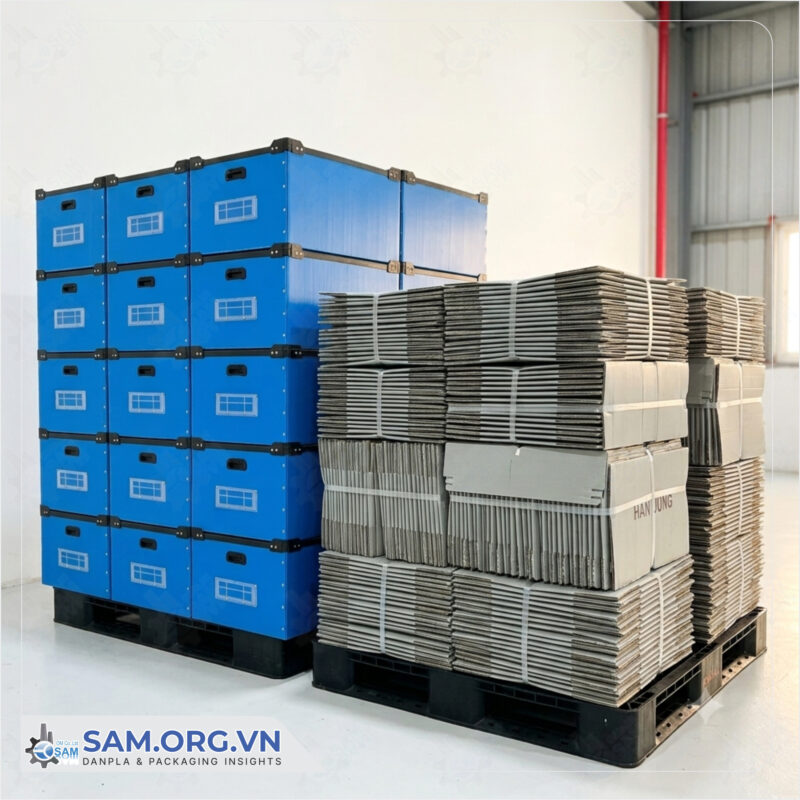
Danpla boxes are made from 100% virgin PP sheet with a hollow corrugated structure — similar to cardboard, but in plastic. This structure delivers a strong strength-to-weight ratio: the boxes are significantly lighter than solid plastic containers of the same load rating, while remaining rigid enough for stacking and handling by hand or forklift.
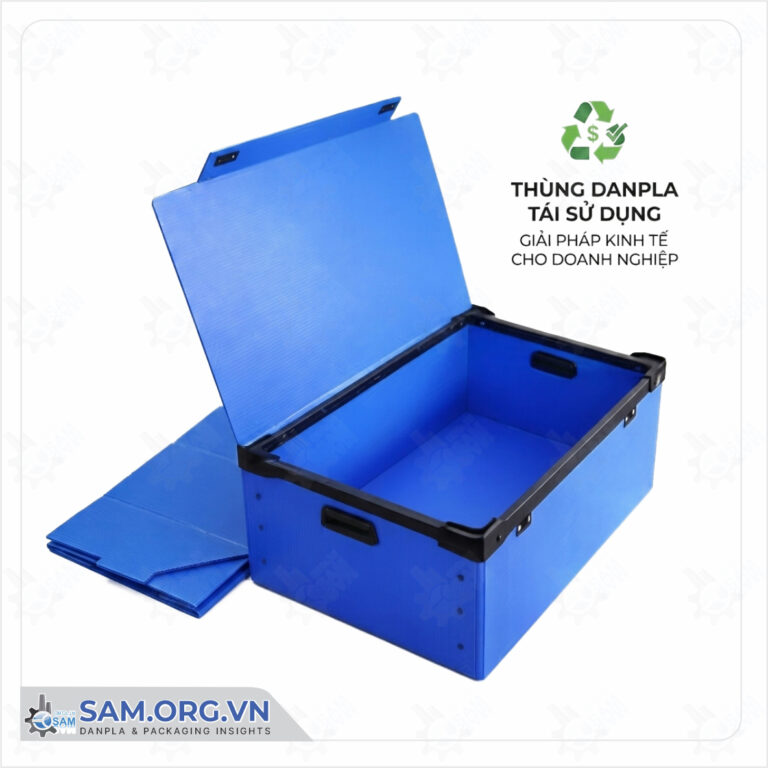
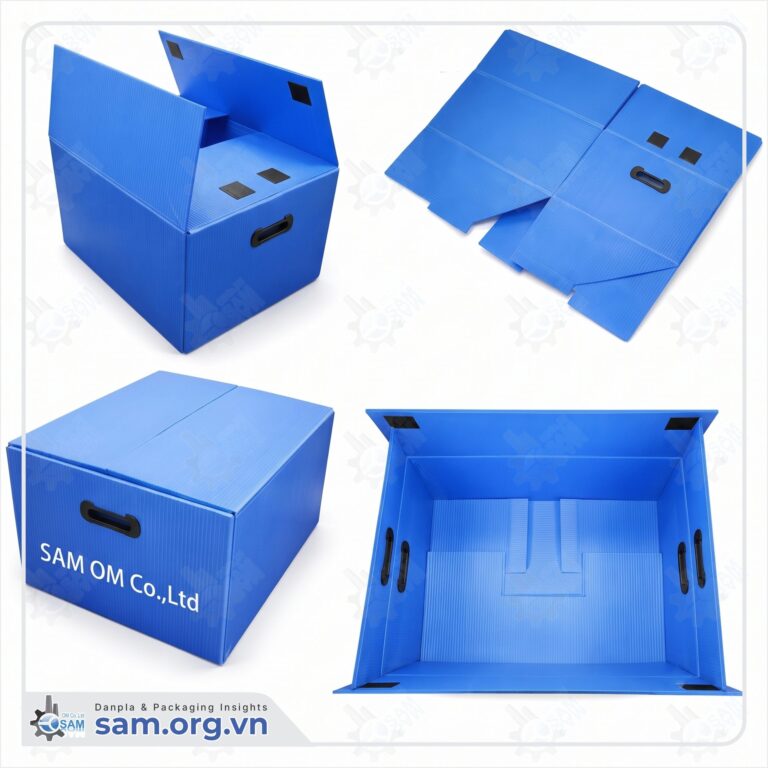
The key advantage over cardboard is reusability. Some models fold flat when empty, reducing return-trip volume and lowering backhaul freight costs. When loaded, the boxes handle typical warehouse conditions well — humidity, dust, and moderate impact during loading and transit.
SAM manufactures Danpla boxes from 2-10mm sheet, in custom dimensions per customer specification. The full production process is certified to ISO 9001:2015 and ISO 14001:2015 (TQC certification, valid through 14 January 2028), meeting supply chain audit requirements from factory customers in Vietnam and abroad.
With a production capacity of 150 tonnes per month across 6 lines in a 5,000 m² facility, SAM fulfills large-volume orders with stable lead times. Currently, SAM serves 300 customers and exports to 15 markets. For procurement teams planning continuous packaging supply for logistics, this scale matters.
Technical Specifications for Logistics Applications
Sheet Thickness and Virgin PP Material by Flow Type
Inter-factory transport typically uses 4-6mm Danpla sheet. This thickness suits consumer goods, mechanical components, and textile products. In contrast, 2-3mm sheet works better for small-parts sorting trays or lightweight containers used in internal warehouse operations.
For heavy-load or multi-tier stacking applications, 8-10mm sheet is the right choice. The required minimum thickness depends on cargo weight and the number of stacking levels. Therefore, SAM recommends discussing actual load requirements before production begins, rather than selecting thickness based on catalog defaults.
100% virgin PP material does not absorb water, does not mold, and does not react with the goods inside. This matters for food, pharmaceutical, and sensitive electronics storage. Moreover, the box surface accepts direct printing or barcode and QR label application, enabling integration with automated scanning lines.
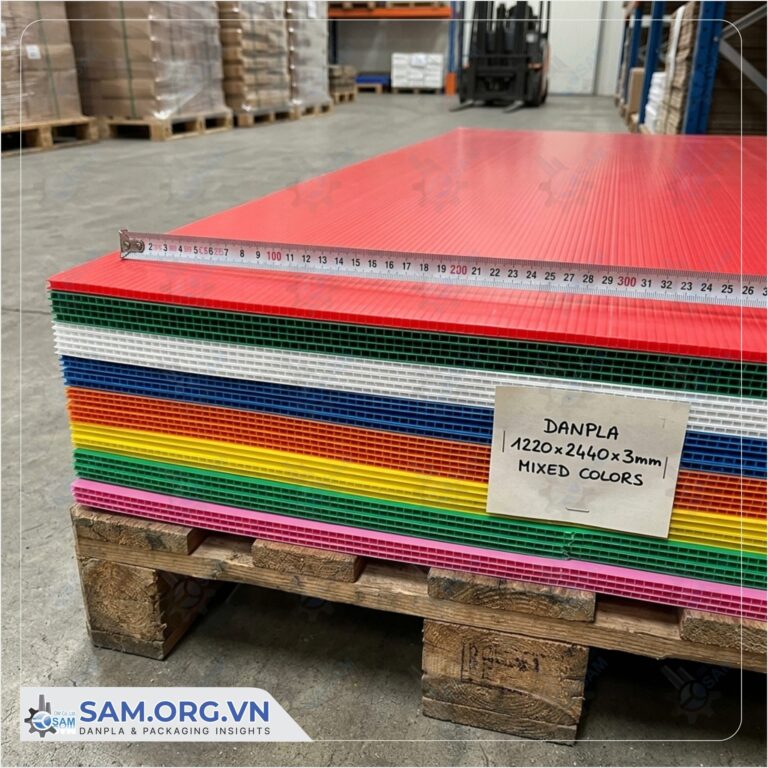
SAM offers 20 standard colors. In practice, a color-coded system lets warehouses sort goods by flow without additional software: blue for inbound, red for items under inspection, yellow for goods in process. This approach works well in high-SKU, multi-shift environments.
Stacking Load, Temperature Limits, and Accessories
Danpla boxes stack when loaded, provided sheet thickness and base design match actual cargo weight. However, one factor often overlooked in planning: stacking capacity also depends on warehouse temperature, since PP softens at elevated heat. Warehouses above 40°C should specify a thicker sheet than the calculated minimum to maintain safe stacking margins.
Edge reinforcement rails, fixed corners, swivel corners, and handles are box accessories that extend service life across multiple use cycles. For boxes handled by hand many times per day, handles reduce handling time and the risk of dropping. These details are often skipped when comparing box prices, yet they significantly affect real-world durability.
Sheet color choice also affects long-term performance in UV-exposed environments. Standard PP without a UV stabilizer degrades faster in direct sunlight. For semi-outdoor or dock-side storage, specify a UV-stabilizer additive at order time. This additive extends material service life without changing structural or barrier properties of the box.
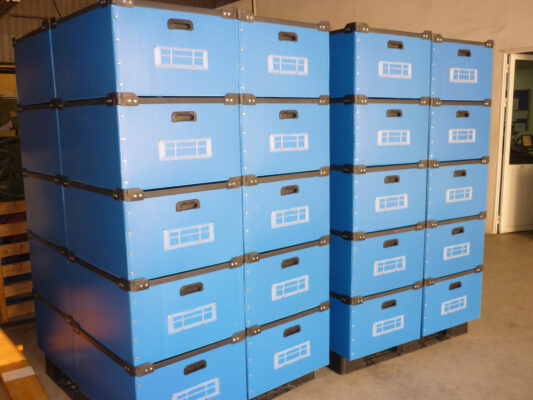
Box dimensions are typically designed in multiples of standard pallet sizes to maximize load density. The 1200x1000mm and 1100x1100mm pallets are the two most common footprints in Vietnamese domestic logistics and for export to Japan, Australia, and the US.
Real-World Applications in Warehousing and Distribution
Inter-Factory Transport Between Production Sites
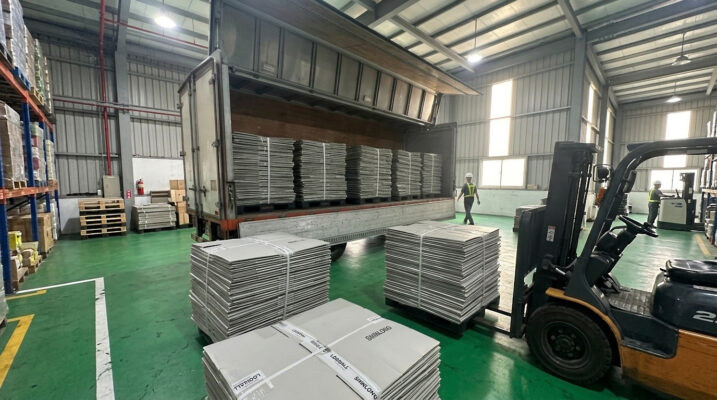
Many manufacturers in Vietnam operate two or three factories across different locations. Components and semi-finished goods move continuously between sites on production schedules. For this type of repeated, fixed-route flow, reusable packaging has a clear cost advantage over single-use cardboard.
Danpla boxes suit this model because dimensions align with standard pallets, eliminating wasted floor space in containers. Empty boxes fold flat on the return trip, reducing volume and cutting backhaul freight costs substantially over time.
The returnable packaging model fits inter-factory flows directly: Factory A ships full boxes to Factory B, and empty boxes return to A on the next trip. As a result, packaging cost per shipment decreases with each additional cycle, unlike cardboard which resets to full cost every time.
Distribution Centers and Multi-Point Delivery
In distribution centers, Danpla boxes hold SKU-specific inventory on shelving racks. Color-coded boxes reduce picking errors. In addition, barcode or QR label surfaces enable automated scanning, lowering mistakes in pick-and-pack operations across high-volume order fulfillment.
For export cargo, Danpla boxes perform well under ocean container conditions. Virgin PP does not absorb water and does not deform under the high humidity present during long ocean voyages. SAM currently serves customers shipping to 15 markets, including Japan, Australia, and the US.
For cold-chain distribution, Danpla boxes offer a practical benefit: the PP material does not absorb condensation. Boxes remain clean and structurally sound through temperature transitions between cold storage and ambient loading docks. This makes them a reliable choice for pharmaceutical and food-grade distribution channels that require hygiene documentation.
Danpla boxes also serve pharmaceutical and food distribution, where hygiene control is strict. Plastic surfaces clean more easily than cardboard and do not retain odors or bacteria after washing with water or standard disinfectant solutions. Furthermore, the non-porous surface prevents contamination between cleaning cycles.
Need technical advice tailored to your production line? Contact SAM’s engineering team — free, no obligation: +84 363 939 228 (Mr. Đạt)
Lifecycle Cost: Danpla Boxes vs Cardboard in Logistics
Cardboard boxes have a low upfront unit price. However, cardboard is single-use in most logistics applications. Therefore, the lifecycle cost is higher when shipment frequency is consistently high.
Danpla boxes cost more initially, but they are reusable many times under normal operating conditions. As a result, the per-use cost decreases steadily with each cycle. After 20-30 uses, each additional trip adds almost no packaging cost to the shipment.
Break-Even Point and Reuse Advantage
For businesses running repeated internal transport routes, the break-even point is typically reached after 15-25 uses, depending on cargo type and handling conditions. Beyond that point, Danpla’s actual cost per shipment is lower than equivalent cardboard for the same cargo volume.
A practical way to model this: divide the box purchase price by the expected number of cycles in one year. For a route running three shipments per week, 150 cycles per year is realistic. At that rate, a Danpla box costs a fraction of cardboard per trip — even before factoring in disposal savings and residual scrap value at end of life.
Danpla boxes generate no waste disposal cost after each shipment. This is an additional benefit for factories building ESG reports or meeting green packaging requirements from international buyers. Moreover, SAM holds ISO 14001:2015 certification, supporting customers who need to demonstrate responsible packaging in their supply chains.
End-of-life residual value is another factor rarely included in cost comparisons. Virgin PP is recyclable and carries scrap buy-back value. Wet or oil-contaminated cardboard cannot be recycled and must be disposed of as waste. Including this factor in the lifecycle analysis further strengthens the case for Danpla in high-frequency logistics operations.
Frequently Asked Questions About Danpla Boxes in Logistics
Can Danpla boxes handle outdoor warehouse conditions?
Danpla boxes made from virgin PP handle moisture and rain well. However, prolonged direct UV exposure gradually reduces material service life. For frequent outdoor use, specify a UV-stabilizer additive when ordering from SAM. In covered warehouses, standard material performs reliably for many years of normal use.
Are custom dimensions available?
Yes. SAM produces boxes to customer-specified dimensions, from small component trays to large pallet-scale containers. Lead time depends on quantity and design complexity. In particular, SAM recommends requesting a sample before full production to verify fit with existing racks, conveyor systems, or vehicle load configurations.
Are Danpla boxes compatible with automated conveyor and warehouse robot systems?
Yes, when the box base is flat and the load weight falls within the conveyor design range. Automated systems sometimes require tighter dimensional tolerances than standard boxes. SAM machines boxes to the precision specifications needed for automation applications. Customers should provide tolerance requirements when ordering so the engineering team can confirm compatibility before production.