VI
VI EN
EN
Antistatic vs Standard Danpla: Why Buyers Must Know the Difference
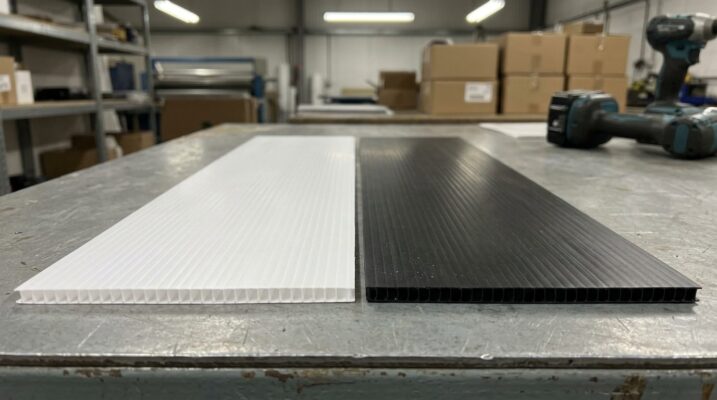
Two Danpla sheets can look identical. They share the same flute, the same thickness, the same light feel. However, one sheet protects your parts while the other quietly destroys them.
A standard Danpla sheet is an insulator. Therefore it holds charge when rubbed, then sparks when it touches a component. For a board, a chip or a sensor head, one discharge can cause a hidden fault. As a result, the product passes inspection but fails weeks later in the field.
Antistatic Danpla, in contrast, drains charge in a controlled way. Buyers in electronics, pharma and precision machining must pick the right grade. A wrong order wastes material. Moreover, it triggers warranty costs and hurts your reputation. This guide shows you how to tell antistatic vs standard Danpla apart, fast and reliably.
ESD damage often stays hidden at first. The part does not fail on the line. Instead, it degrades slowly and fails later. Therefore the real cost sits in warranty claims and recalls. Choosing the right material upfront, as a result, is far cheaper.
The Real Difference Between the Two Sheets
Both sheets use virgin PP with the same hollow flute core. However, they differ in how they carry and drain surface charge. Once you grasp this, appearance no longer fools you.
Standard Danpla: an insulating material
Pure PP insulates well. Therefore the surface resistance of a standard sheet exceeds 10¹² Ω/sq. Charge from friction has nowhere to go. Instead, it stays on the surface until it meets a conductor and jumps across.
For mechanical parts, food or produce, this trait is harmless. For static sensitive components, however, it is a real risk. As a result, standard sheets should never divide a tray of boards.
You can sense this trait with a simple observation. A standard sheet clings to dust and small foam beads. An antistatic sheet, by contrast, sheds them far more easily. This difference, moreover, hints at how each handles charge. Still, use the meter to confirm what your eyes suggest.
Antistatic Danpla: surface coating or conductive filler
Antistatic Danpla uses two main technologies. The topical type, for example, comes clear or pink. Its coating draws moisture and forms a thin conductive layer. However, this effect fades over time and with low humidity.
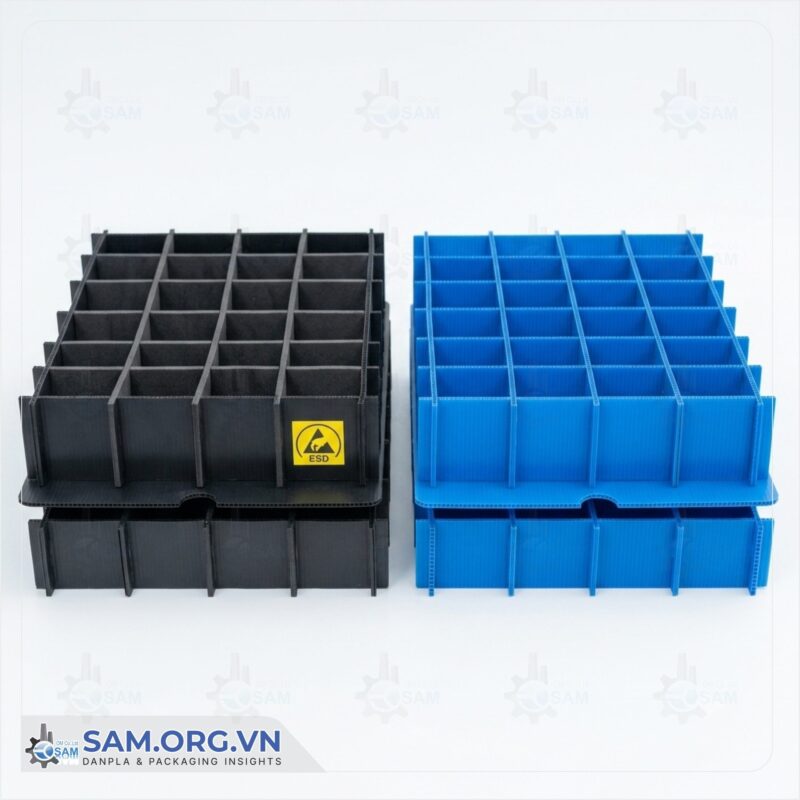
The second type blends conductive carbon into the resin, which gives it a distinct black color. Because the property sits inside the material, it lasts permanently. Therefore this black grade suits partitions and component trays best. For the core structure, see our Danpla sheets page.
Which industries must use the antistatic grade
Not every industry needs an antistatic grade. The clearest group, however, is electronics and semiconductors. Boards, sensors and drives all react to discharge. Therefore an SMT area almost always uses dissipative trays and partitions.
Beyond electronics, cleanroom pharma also watches static dust. Precision machining and optics, moreover, avoid particles on the surface. Some automotive lines carry similar sensitive electronic modules. When your goods fall in these groups, therefore, weigh the right grade carefully.
The cost of a wrong call rises with part value. A single reel of chips, for instance, can outvalue a pallet of sheets. Therefore matching the grade to the part is simple economics. In short, higher part value justifies a stricter grade.
Four Ways to Identify an Antistatic Sheet
No single glance is foolproof. However, combining a few signs gives a reliable verdict. Below are four checks, ranked from quick to certain.
Check by eye: color and markings
Conductive Danpla is almost always black. The topical type, meanwhile, tends to be pink or translucent. Standard sheets, by contrast, come in white, blue, yellow and red. Our Danpla color coding guide explains this system.
Many makers print an ESD mark or a lot code on the surface. In addition, the product label states the surface resistance or the dissipative grade. Still, black alone proves nothing, because some black sheets are only dyed. Therefore treat color as a first hint, not as evidence.
Check by surface finish and feel
Carbon-filled sheets usually have a matte, low-gloss surface. Under angled light, therefore, they do not reflect as sharply as dyed sheets. To the touch, moreover, they feel slightly rougher. Still, this is only a supporting sign, not proof on its own.
The topical type sometimes leaves a faintly slick film. In dry air, as a result, it attracts far less dust than a standard sheet. Checking dust patterns in the warehouse is a quick trick. However, it misleads easily when humidity shifts through the day.
Check by surface resistance measurement
This is the only sure method. Place a surface resistance meter with two probes on the sheet. The meter reads a value in Ω/sq. An insulating sheet reads off the scale. An antistatic sheet, however, lands inside the dissipative range.
If you lack a meter, ask the supplier for a test report. For consistency, the test should follow IEC 61340-5-1 or ANSI/ESD S20.20. For large lots, moreover, you should measure a few random sheets at incoming inspection.
Cross-check the test report and datasheet
Every compliant lot should ship with a datasheet and a test report. The papers state the grade, the resistance range and the standard applied. Therefore matching the lot code on the sheet to the report is the final step. When the figures agree, you hold traceable proof.
Missing paperwork is a clear warning sign. Some sellers, for example, pass dyed black sheets off as antistatic. Asking for a test report before intake removes that risk. In addition, keep each datasheet so you can compare repeat deliveries later.
Need technical advice tailored to your production line? Contact SAM’s engineering team, free and with no obligation: +84 363 939 228 (Mr. Đạt)
Classification by Surface Resistance Range
Antistatic is not a single level. Instead, the industry splits materials into grades by surface resistance. Once you know the ranges, you can order the right grade, neither too much nor too little.
| Grade | Surface resistance (Ω/sq) | Key trait |
|---|---|---|
| Conductive | below 10⁵ | Drains charge fastest, for the strictest zones |
| Dissipative | 10⁶ to 10¹¹ | Controlled drain, common for electronics packaging |
| Antistatic | 10⁹ to 10¹² | Limits charge build-up and surface dust |
| Insulative (standard) | above 10¹² | No static control |
Which grade fits which application
For board partitions and trays, choose the dissipative grade. The 10⁶ to 10⁹ Ω/sq band, for example, balances safety and cost. A sensitive chip assembly area, however, may need the conductive grade. The topical type, meanwhile, suits short-life temporary packaging.
A grade that is too high wastes money, while one too low fails to protect. Therefore the deciding factor is the ESD sensitivity of the part. Your factory ESD team usually holds this figure. When in doubt, send a sample part so the supplier can propose the right grade.
In practice, most electronics buyers settle on the dissipative band. It covers trays, partitions and liners at a sensible cost. For rare high-risk steps, however, a conductive grade earns its price. Reviewing the risk per step, therefore, keeps the budget in check. In short, buy the grade the risk demands, no more.
How long the antistatic property lasts
Not every grade holds its property equally over time. The carbon-filled type, however, keeps a steady resistance for its whole life. Temperature and humidity barely change it. Therefore this grade fits packaging that cycles many times through the plant.
The topical type depends on ambient humidity. In a dry room, as a result, the thin layer weakens and resistance climbs. After repeated washing, moreover, its effect fades further. For long-life needs, therefore, favor the carbon-filled grade.
Why humidity affects the reading
Surface resistance shifts with temperature and humidity. The same sheet, therefore, can read two values in two rooms. For this reason, the standard asks you to record the conditions. Usually the test runs at a fixed humidity and temperature.
The topical type reacts to humidity more than the carbon type. When comparing lots, therefore, measure under the same conditions. Ignoring this factor leads to false conclusions. Logging the temperature and humidity at each test, moreover, is good practice.
Order the Right Grade for Your Line
Picking the right grade is only half the job. The other half is finding a fabricator who holds the spec steady across every lot. Antistatic material drifts easily when the carbon mix is uneven or the coating runs thin.
SAM makes antistatic Danpla sheets and partitions from virgin PP, 2 to 10mm thick. Each lot ships with a surface resistance figure for incoming checks. The plant holds ISO 9001:2015 and ISO 14001:2015, with output above 150 tonnes per month. Electronics customers such as Canon, LG and Sumitomo Electric, moreover, set strict ESD requirements.
For partitions, the team cuts and dies to your exact tray by CNC. Our ESD Danpla partitions page covers this line in detail. In addition, our SMT component packaging guide explains staging near the placement step. Sending a sample part, therefore, is the fastest way to get the right grade.
Common buyer mistakes to avoid
Many buyers judge a sheet by color alone. As a result, they accept dyed black stock as antistatic. Others skip the test report to save time. However, that shortcut often surfaces later as field failures.
Another common slip is mixing grades on one line. For example, a dissipative tray with an insulating lid still risks discharge. Therefore keep every contact surface within the same ESD plan. Reviewing the whole path, moreover, matters more than any single part.
A final mistake is ordering without a written spec. Verbal grades, for example, get lost between teams. Putting the range and standard on paper, therefore, protects both sides. It also speeds up any later dispute over a lot.
What to specify in your purchase order
A clear order prevents receiving the wrong grade. Therefore write four core specs on the PO. First, state the grade, for example dissipative or conductive. Second, state the target surface resistance range in Ω/sq.
Third, give the thickness and color, for example 3mm black. Fourth, request a test report to IEC 61340-5-1. Noting the end application, moreover, helps the supplier advise well. The more specific the order, as a result, the fewer delivery errors.

Frequently Asked Questions
Is a black Danpla sheet always antistatic?
No. Black usually signals a carbon-filled grade. However, some black sheets are only dyed for looks. Therefore the sure check is a surface resistance measurement or a supplier test report. Do not judge by color alone.
How do topical and carbon-filled types differ?
The topical type forms a thin conductive layer on the surface. As a result, its effect fades with time and humidity. The carbon-filled type, in contrast, carries the property through the whole material, so it lasts. For reusable packaging, therefore, the carbon-filled type is more reliable.
What equipment measures surface resistance?
You need a surface resistance meter with two standard probes. Place it on the sheet, then read the value in Ω/sq. For consistent results across lots, follow IEC 61340-5-1 or ANSI/ESD S20.20.
Can antistatic Danpla be cut and folded like standard sheets?
Yes. Both types cut, crease and die with the same tooling. However, keep the surface clean so you do not lower its drain capacity. For the topical type, moreover, avoid wiping with strong solvents.